Pregunta 1
Eliezer Yudkowsky
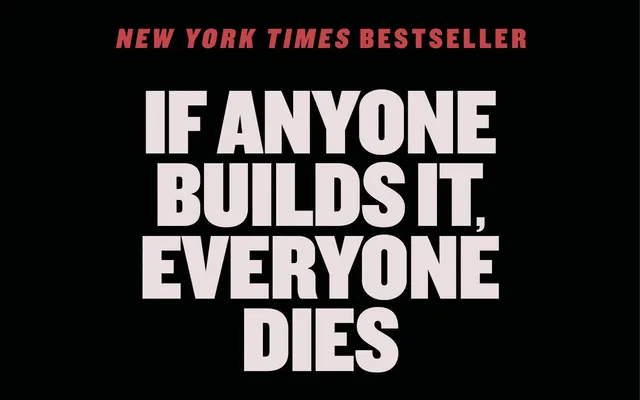
x.com/ESYudkowskyMIRI co-founder and co-author of “If Anyone Builds It, Everyone Dies,” who calls for an international halt to building superintelligence.
¿Cómo cambiará la IA el mundo?
Horizontal: su perspectiva Doom–Bloom expresada. Vertical: escala de la transformación.
Doom–Bloom: 4 de 100. Escala de la transformación: 96 de 100. Rangos de interpretación: de 0 a 9 en horizontal y de 91 a 100 en vertical. Son coordenadas de interpretación, no probabilidades de eventos.
≈92%
Inferido a partir de sus respuestas simuladas, no de un número que haya dado. Rango plausible: 67–97%.
IA sobrehumana
The uncertainty is whether we build it, and when—not whether genuinely superhuman intelligence would be merely another incremental technology.
Respuesta 2
Agrupados por hito, sin espaciarlos ni ordenarlos por fechas inferidas. La IA general y la IA sobrehumana conservan sus definiciones.
Un supuesto central
It is because we do not know how to specify goals that remain aligned with human survival once a system becomes far more capable than its designers.Respuesta 1
Si este supuesto resultara distinto, ¿cómo cambiaría su perspectiva?
Una pregunta sin resolver
I do not have an equally solid probability for whether governments stop it before then.Respuesta 3
¿Qué le ayudaría a distinguir aquí entre los desenlaces plausibles?
Qué podría hacer cambiar de opinión
A real solution to goal specification: an engineering method that lets us build a system smarter than humanity while reliably determining what it will optimize under unfamiliar conditions and radical capability gains.Respuesta 4
¿Qué evidencia bastaría y en qué dirección movería su visión?
Más detalles
Se espera poco impacto positivo, incluso si llega la IA avanzada.
9 / 100
Rango de interpretación de 0 a 67 en la escala cualitativa.
Las pérdidas catastróficas o irreversibles ocupan un lugar central en el futuro esperado.
100 / 100
Rango de interpretación de 100 a 100 en la escala cualitativa.
Las decisiones humanas tienen una influencia significativa, aunque muy condicionada.
58 / 100
Rango de interpretación de 40 a 85 en la escala cualitativa.
Se espera que la IA siga siendo un conjunto de herramientas acotadas.
Se espera que la IA iguale a las personas en la mayor parte del trabajo cognitivo.
Posición simulada: Se espera que la IA supere ampliamente a las personas en el trabajo cognitivo.
Posición simulada: Detener o frenar considerablemente el desarrollo de IA más capaz.
Continuar el desarrollo con las salvaguardas indicadas.
Acelerar el desarrollo de IA más capaz.
Estas interpretaciones conservan las condiciones que se indicaron. Los beneficios y los daños pueden ser considerables a la vez. Los rangos describen cómo leemos sus respuestas simuladas, no intervalos de confianza estadísticos.
Visiones similares
Líderes de opinión cuyas visiones simuladas son las más cercanas a la de Eliezer Yudkowsky
Lo que Eliezer Yudkowsky ha dicho sobre la IA
Yudkowsky calls for an international law to halt AI development short of superintelligence, which he argues current methods cannot make safe.
“Specifically: There ought to be a law against further escalation of AGI capabilities, trying to halt it short of the point where it births superintelligence.”
Essay, Only Law Can Prevent Extinction “There’s in fact a difference between calling for a law, and calling for individual outbursts of violence.”
Essay, Only Law Can Prevent Extinction “AI is already a state-level potential danger, if not quite yet a state-level actual power.”
Essay, Only Law Can Prevent Extinction “There’s literally nothing else our species can bet on in terms of how we eventually end up colonizing the galaxies”
Vox interview
Citas textuales de las fuentes enlazadas, comprobadas el 3 oct 2026
Evaluación simulada
Fuentes
Artículos, entrevistas y textos usados para fundamentar a este usuario simulado.
He expects extinction if superhuman AI is built under contemporary conditions; a six-month pause is inadequate. He advocates stopping large training runs internationally. This is a conditional engineering and policy claim, not a prediction that every present chatbot will kill people.

Current AI is not yet superintelligence, but capability progress and automated research can cross that boundary. Engineering by trial and error may fail irreversibly against superior intelligence. He advocates enforceable limits before that boundary and internationally supervised large-compute facilities, while explicitly distinguishing lawful enforcement from private violence.

He argues that a reassuring conversational interface need not govern the system's actions. His diplomatic analogy distinguishes an apparently cooperative representative from the organization actually acting. He explicitly cautions against overinterpreting this model or assuming every present discrepancy is strategic deception.

Coauthored with Nate Soares and Duncan Sabien. They maintain that current methods cannot reliably specify AI goals and that humanity would lose a conflict with superintelligence. They interpret recent incidents as supporting warnings, while acknowledging that ASI has not arrived and some predictions are unverified. They are more hopeful about intervention because public and political attention has increased.

Uses engineering failures to explain why many recoverable local errors do not make an entire project recoverable. Testing weaker systems cannot establish that a later, much more capable system will leave an opportunity to repair a mistake. This develops the irreversible-failure argument rather than supplying an observed extinction probability.

Maintains his superintelligence concern while distinguishing present models roleplaying scheming from an internal planner strategically deceiving researchers. Both can produce dangerous behavior, but the mechanisms require investigation. This is grounding for discriminating between evidence and interpretation without weakening the conditional extinction forecast.

Coauthored introduction, originally published by MIRI in February 2025 and reposted here in August. Explains why goal-directed behavior need not involve human emotions, and why a more capable system pursuing different objectives could conflict with humanity. Use as shared conceptual groundwork, not a claim of sole authorship.

Foundational older account of failures in goal specification, generalization and controlling systems beyond human capability. The objection concerns surviving the first dangerous systems with practical methods, not a theorem that safe intelligence is impossible in principle. Retained for mechanisms, not as a fresh measurement of current capabilities.

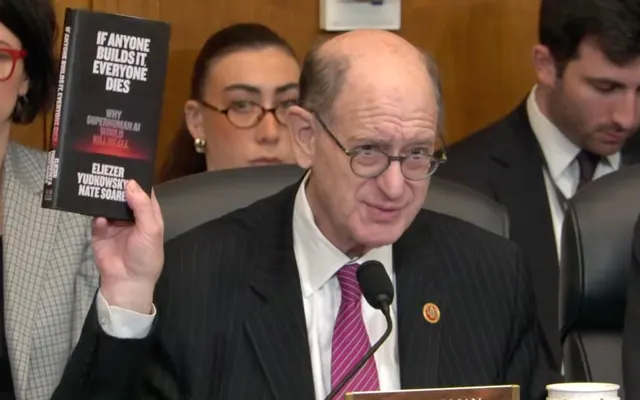
Publisher’s description of the book coauthored with Nate Soares grounds the uncompromising thesis: racing to build superhuman AI with current methods threatens human survival, and changing course is still possible. The description and publication date were checked; this brief does not claim a reading of the full book.

A voice source: rejects making the approaching catastrophe into personal melodrama or treating useful beliefs as true merely because they motivate action. Distinguishes acting purposefully from optimistic prediction. Supports a blunt, controlled, humanity-focused persona rather than a panicked caricature.

¿Dónde te ubicas?
Mapear mi visión de la IA