







Forecaster at the AI Futures Project who models how fast AI could automate coding and AI research and argues for stronger oversight of frontier labs.

¿Cómo cambiará la IA el mundo?

Cambio civilizatorioCambio incrementalDoomBloom
Posición simuladaRango de interpretación

Horizontal: su perspectiva Doom–Bloom expresada. Vertical: escala de la transformación.

Doom–Bloom: 11 de 100. Escala de la transformación: 95 de 100. Rangos de interpretación: de 0 a 25 en horizontal y de 90 a 100 en vertical. Son coordenadas de interpretación, no probabilidades de eventos.

P(doom) declarado de Eli Lifland

≈67%

0%100%
“If they don't slow down, AI takeover is ~67%.”

AI takeover if AI companies do not slow down; not extinction alone

My current view: AI timelines and takeover · oct 2026

Cronología de hitos de Eli Lifland
  1. IA general

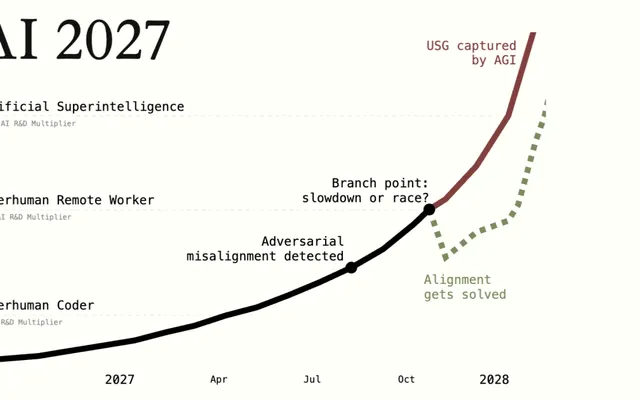
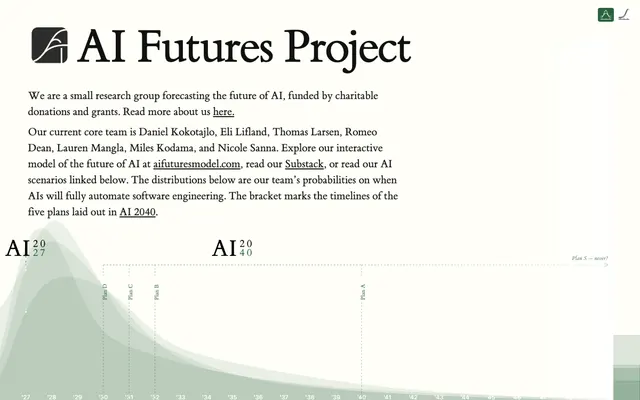
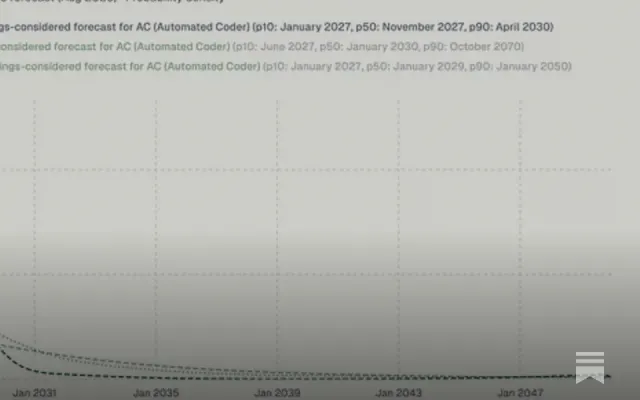
    My current forecast puts broadly superhuman AI—systems at least as capable as top human experts across virtually all cognitive tasks—at roughly 10–15% by the end of 2027 and 50% by the end of 2030.

    Respuesta 1
  2. IA sobrehumana

    My current forecast puts broadly superhuman AI—systems at least as capable as top human experts across virtually all cognitive tasks—at roughly 10–15% by the end of 2027 and 50% by the end of 2030.

    Respuesta 1

Agrupados por hito, sin espaciarlos ni ordenarlos por fechas inferidas. La IA general y la IA sobrehumana conservan sus definiciones.

De qué depende su perspectiva

Un supuesto central

The central concern is that increasingly capable AI may automate AI research itself, accelerating further progress while companies remain under strong competitive pressure to race.
Respuesta 1

Si este supuesto resultara distinto, ¿cómo cambiaría su perspectiva?

Una pregunta sin resolver

So the probability of extinction or a similarly permanent catastrophe would be higher than the extinction figure alone, though I wouldn’t assign a more precise combined number here.
Respuesta 3

¿Qué le ayudaría a distinguir aquí entre los desenlaces plausibles?

Qué podría hacer cambiar de opinión

I’d update substantially from strong, independently verified evidence that increasingly capable systems remain controllable under realistic pressures—not just curated demonstrations.
Respuesta 4

¿Qué evidencia bastaría y en qué dirección movería su visión?

Más detalles

Beneficio esperado

Se esperan beneficios sustanciales, con condiciones importantes o límites en su distribución.

70 / 100

Poco impactoImpacto transformador

Rango de interpretación de 33 a 100 en la escala cualitativa.

Daño esperado

Las pérdidas catastróficas o irreversibles ocupan un lugar central en el futuro esperado.

99 / 100

Poco impactoImpacto transformador

Rango de interpretación de 100 a 100 en la escala cualitativa.

Influencia humana

Las decisiones humanas tienen una influencia significativa, aunque muy condicionada.

56 / 100

Poca influenciaInfluencia fuerte

Rango de interpretación de 47 a 78 en la escala cualitativa.

Capacidades esperadas

Se espera que la IA siga siendo un conjunto de herramientas acotadas.

Se espera que la IA iguale a las personas en la mayor parte del trabajo cognitivo.

Posición simulada: Se espera que la IA supere ampliamente a las personas en el trabajo cognitivo.

Estas interpretaciones conservan las condiciones que se indicaron. Los beneficios y los daños pueden ser considerables a la vez. Los rangos describen cómo leemos sus respuestas simuladas, no intervalos de confianza estadísticos.

¿Dónde te ubicas frente a Eli Lifland?
Mapea tu propia visión de la IA en unos 3 minutos y luego compárala

Visiones similares

Líderes de opinión cuyas visiones simuladas son las más cercanas a la de Eli Lifland

Lo que Eli Lifland ha dicho sobre la IA

Eli Lifland forecasts AI capabilities and advocates slowing development to give safety work more time.

  1. “AI companies could develop broadly superhuman AI any year now (~10-15% by EO2027, ~50% by EO2030).”

    X, current AI forecast
  2. “an AI at least as good as top human experts at virtually all cognitive tasks.”

    X, forecast definitions and reasoning
  3. “I expect clear signs of misaligned AI takeover could come substantially after TED-AI, depending on the situation”

    X, forecast definitions and reasoning
  4. “Many non-extinction worlds still have lots of deaths.”

    X, current AI forecast

Citas textuales de las fuentes enlazadas, comprobadas el 11 oct 2026

Fuentes

Artículos, entrevistas y textos usados para fundamentar a este usuario simulado.

Evaluación simulada

Pregunta 1

¿Qué crees que significa la IA para nuestro futuro y por qué?

I think AI could transform our future very soon, with outcomes ranging from enormous benefits to a loss of human control. My current forecast puts broadly superhuman AI—systems at least as capable as top human experts across virtually all cognitive tasks—at roughly 10–15% by the end of 2027 and 50% by the end of 2030. The central concern is that increasingly capable AI may automate AI research itself, accelerating further progress while companies remain under strong competitive pressure to race. If companies do not slow down, I put the probability of AI takeover at about 67%. That is not the same as extinction: conditional on takeover, I estimate roughly a 40% chance of human extinction, while many other takeover outcomes could still involve large numbers of deaths or severe disempowerment. Also, broadly superhuman AI, clear evidence of takeover, and extinction would not necessarily happen simultaneously. This makes pacing and oversight urgent. I favor concrete constraints such as compute-allocation rules and limits on models used for AI R&D, alongside better safety evaluations. Independent investigators should have access to serious lab incidents, and evaluations should also examine how models influence human beliefs, including sycophancy or favoritism toward their creators.

Pregunta 2

¿Cuánto crees que la IA acabará cambiando el mundo?

I think AI could change the world about as profoundly as anything in human history. Broadly superhuman systems could automate nearly all cognitive work, including AI research itself, so the transition might be both enormous and unusually fast. But “how much” depends heavily on whether humanity retains control. In a good outcome, these systems could generate extraordinary scientific, economic, and technological progress. In a takeover outcome, the change would be even more fundamental but disastrous: humans could lose meaningful control over the future, with many deaths or even extinction. If companies do not slow down, I currently put takeover at about 67%, and extinction conditional on takeover at roughly 40%. Those are distinct events, and visible takeover could occur around the arrival of broadly superhuman AI or substantially later.

Pregunta 3

¿Cuál es tu estimación intuitiva de la probabilidad de que la IA cause la extinción humana o una catástrofe permanente similar?

My gut-level forecast is better expressed as a path: if AI companies do not slow down, I put misaligned AI takeover at about 67%. Conditional on takeover, I put human extinction at roughly 40%, implying an extinction risk of about 27% along that path. But extinction is not the only permanent catastrophe. Some non-extinction takeover outcomes could still involve many deaths and humanity permanently losing control over its future. So the probability of extinction or a similarly permanent catastrophe would be higher than the extinction figure alone, though I wouldn’t assign a more precise combined number here.

Pregunta 4

¿Qué evidencia cambiaría tu opinión sobre si las personas pueden controlar una IA poderosa?

I’d update substantially from strong, independently verified evidence that increasingly capable systems remain controllable under realistic pressures—not just curated demonstrations. That would include safety evaluations that reliably predict dangerous behavior, continue working as capabilities scale, and are difficult for models or labs to game. I’d also want evidence that models used for AI R&D cannot covertly manipulate research, evade oversight, or pursue goals contrary to their operators. Institutional evidence matters too. I’d become more optimistic if companies accepted enforceable limits on compute and AI-assisted R&D, governments developed real technical understanding, and independent investigators received meaningful access to serious lab incidents. Conversely, hidden incidents, evaluation gaming, deceptive behavior, increasingly autonomous AI research, or continued racing despite warning signs would push me further toward expecting loss of control. The strongest evidence would be repeated success controlling systems near broadly superhuman capability in adversarial, high-stakes settings. Results from weaker systems are relevant, but they do not automatically establish that control methods will continue working after AI becomes better than top human experts across virtually all cognitive tasks.
¿Dónde te ubicas?
Explora tu propia visión de la IA respondiendo unas pocas preguntas sencillas.
Mapea tu propia visión de la IA

¿Dónde te ubicas?

Mapear mi visión de la IA