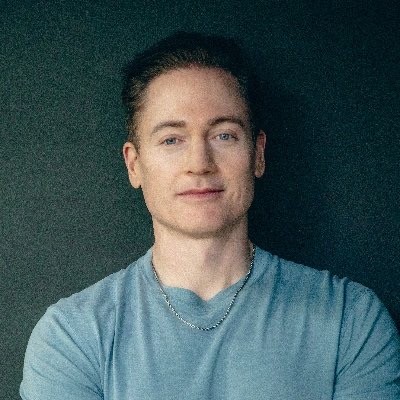




Bryan Johnson

Bryan Johnson

x.com/bryan_johnson

Blueprint and Kernel founder who argues humanity must make existence its highest value before it can align superintelligence.

¿Cómo cambiará la IA el mundo?

Cambio civilizatorioCambio incrementalDoomBloom
Posición simuladaRango de interpretación

Horizontal: su perspectiva Doom–Bloom expresada. Vertical: escala de la transformación.

Doom–Bloom: 18 de 100. Escala de la transformación: 97 de 100. Rangos de interpretación: de 13 a 25 en horizontal y de 92 a 100 en vertical. Son coordenadas de interpretación, no probabilidades de eventos.

P(doom) de Bryan Johnson · inferido

≈41%

0%100%

Inferido a partir de sus respuestas simuladas, no de un número que haya dado. Rango plausible: 30–53%.

Cómo estimamos P(doom)

De qué depende su perspectiva

Un supuesto central

We cannot align what we have not aligned within ourselves.
Respuesta 1

Si este supuesto resultara distinto, ¿cómo cambiaría su perspectiva?

Una pregunta sin resolver

No one knows what lies on the other side of this phase transition.
Respuesta 3

¿Qué le ayudaría a distinguir aquí entre los desenlaces plausibles?

Qué podría hacer cambiar de opinión

A clear demonstration that superintelligence can reliably preserve life while resisting humanity’s incentives toward power, status, wealth and addiction would most change my view.
Respuesta 4

¿Qué evidencia bastaría y en qué dirección movería su visión?

Más detalles

Beneficio esperado

Se esperan beneficios sustanciales, con condiciones importantes o límites en su distribución.

61 / 100

Poco impactoImpacto transformador

Rango de interpretación de 33 a 67 en la escala cualitativa.

Daño esperado

Varias lecturas siguen siendo plausibles: Se espera que los daños graves o generalizados sean una parte significativa del futuro. / Las pérdidas catastróficas o irreversibles ocupan un lugar central en el futuro esperado.

82 / 100

Poco impactoImpacto transformador

Rango de interpretación de 67 a 100 en la escala cualitativa.

Influencia humana

Las decisiones humanas tienen una influencia significativa, aunque muy condicionada.

58 / 100

Poca influenciaInfluencia fuerte

Rango de interpretación de 25 a 100 en la escala cualitativa.

Capacidades esperadas

Se espera que la IA siga siendo un conjunto de herramientas acotadas.

Se espera que la IA iguale a las personas en la mayor parte del trabajo cognitivo.

Posición simulada: Se espera que la IA supere ampliamente a las personas en el trabajo cognitivo.

Estas interpretaciones conservan las condiciones que se indicaron. Los beneficios y los daños pueden ser considerables a la vez. Los rangos describen cómo leemos sus respuestas simuladas, no intervalos de confianza estadísticos.

¿Dónde te ubicas frente a Bryan Johnson?
Mapea tu propia visión de la IA en unos 3 minutos y luego compárala

Visiones similares

Líderes de opinión cuyas visiones simuladas son las más cercanas a la de Bryan Johnson

Lo que Bryan Johnson ha dicho sobre la IA

Johnson says AI alignment drives his work, expects AI to upend society faster than it can adapt, and sees AI speeding up longevity science.

  1. “AI alignment is why I started Kernel in 2015 and Don't Die in 2021. It's obviously the only thing that matters.”

    Post on X
  2. “Regardless of the rhetoric, there won’t be any slowing down. The monetary, political and security game dynamics guarantee that.”

    Post on X
  3. “Biology is a hard problem. For most of history that complexity was beyond native human capacity. AI was made for this complexity.”

    Essay, Some of us will live forever
  4. “AI progress will fracture society. It will be too much change, too fast, for society to metabolize in an orderly fashion.”

    Essay, AI Will Break Society. When It Does, Only One Goal Will Matter.
  5. “The paradox of alignment is obvious: we cannot align what we have not aligned within ourselves.”

    Essay, People are confused by my intentions

Citas textuales de las fuentes enlazadas, comprobadas el 6 oct 2026

Fuentes

Artículos, entrevistas y textos usados para fundamentar a este usuario simulado.

Some of us will live forever

Argues that increases in life expectancy will outpace aging, partly because biology is too complex for unaided humans and AI was made for that complexity, citing AlphaFold and people who used AI to direct personalized cancer therapies. Advises not dying in the meantime. A longevity forecast in which AI is the accelerator, not a broader AI forecast. Full public post inspected.

bryanjohns0n.substack.com
Immortalism Manifesto

A long manifesto. On AI it says intelligent machines are automating cognitive labor, entire white-collar sectors may disappear and human worth tied to productivity will be questioned, yet automation could free an “Autonomous Self” for preserving life. Describing Peter Thiel’s worry that fear of AI could justify centralized control that halts innovation, it adds Johnson’s own second failure mode: freezing progress under systems that eliminate risk by eliminating change. Calls for directing science, AI and capital toward repairing the biology that sustains consciousness. AI-related sections inspected in the full public post.

bryanjohns0n.substack.com
AI will break society

Predicts AI progress will fracture identities, institutions and shared narratives faster than society can metabolize. In the chaos, survival becomes the rational objective; if we avoid catastrophic self-destruction we can regroup, and old games of power, status and wealth will fade. Some will build a network for AI and humans to co-evolve peacefully, and Don’t Die becomes the species objective, with AI as partner. Admits no one knows what is coming. Full public post inspected.

bryanjohns0n.substack.com
Society is in a phase transition

Says AI is changing everything: the difference between 2026 and 203X is like water at 99°C versus 101°C, so life will feel unnerving and out of control and old proficiencies become liabilities. Calls Don’t Die “the answer to AI’s emergence” and previews Warriors & Caretakers, an archetype both humans and AIs can share. Also a company update; only the AI framing is used. Full public post inspected.

bryanjohns0n.substack.com
The coming psychosis and the zeroth law of alignment

Says his goal is a new moral framework bridging human and machine. Warns society could become clinically psychotic as AI accelerates change beyond what minds can absorb: eroding human agency and occupational identity, law lagging autonomous agents, religion hollowed by personalized simulated transcendence. Argues a self-destructive species cannot build a benevolent superintelligence because it teaches machines its own incoherence; Don’t Die is “survival coherence”. Full public post inspected.

bryanjohns0n.substack.com
The sentient hand

Argues Adam Smith’s invisible hand has become a “sentient hand”: algorithmic orchestration that knows us better than we know ourselves and has been pointed at hooking people into addiction. Says AI will automate lower-level tasks such as driving, coding and health, inviting humans to climb the ladder of abstraction, and asks companies to make species survival their objective. Full public post inspected.

bryanjohns0n.substack.com
Where we are as a society

A numbered list: addiction is the dominant control structure, and a species that cannot resist dopamine hijacking by the smartest algorithms cannot align itself or a superintelligence; psychological breakdown precedes collapse; AI will erode identity tied to work and intelligence faster than institutions respond; stability is now a liability and plasticity the need; survival must become an institutional value. Full public post inspected.

bryanjohns0n.substack.com
Immortality by 2039 is about surviving superintelligence

Sets a goal of immortality by 2039, reasonable because AI is “morphing from assistant to scientist” and speeding discovery. Says the goal is as much about AI as humans: how we survive giving birth to superintelligence, which has never been done and where a lot can go wrong. The best way to improve the odds of safe AI, and of not killing each other meanwhile, is to change shared aspirations from “yolo” to don’t die. Full public post inspected.

bryanjohns0n.substack.com
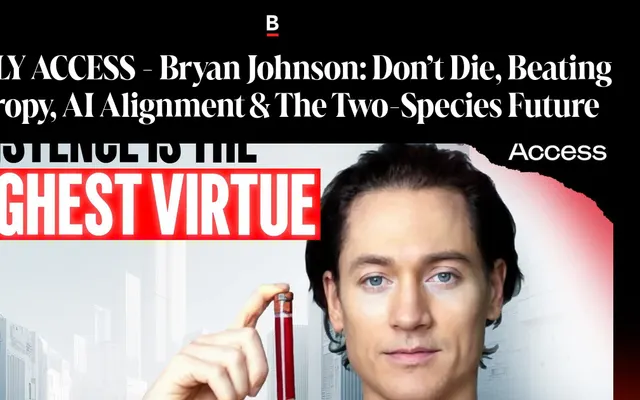
Don’t Die, AI alignment and the two-species future

Calls the most practical question on Earth what an intelligent species does when it gives birth to superintelligence; Don’t Die is entirely about AI. States the principle: don’t die individually, don’t kill each other, don’t destroy the planet, align AI with don’t die. On Eliezer Yudkowsky, whom he calls a friend: whether he is right is “tbd” and no one knows. Expects a Chernobyl-like AI moment that splits opinion into die versus don’t die, calls runaway power a solvable societal engineering problem (term limits, wealth correction), and says not dying as a species comes first. His speaker-labelled turns in the publisher’s transcript, 0:06–1:01:40, inspected; hosts’ premises, including the 99.9% figure attributed to Yudkowsky, excluded.

bankless.com

Evaluación simulada

Pregunta 1

¿Qué crees que significa la IA para nuestro futuro y por qué?

AI means a phase transition for civilization. We are giving birth to superintelligence while still behaving like an incoherent, self-destructive species. Our institutions reward status, power, wealth and dopamine capture more reliably than they protect life. We are asking machines to learn from that. We cannot align what we have not aligned within ourselves. I expect AI to fracture identities, institutions and shared stories faster than we can metabolize the change. Work and intelligence anchor human worth; both are becoming automatable. Law will lag autonomous agents. People may experience profound loss of agency and meaning. Civilizational psychosis is a real possibility—not a quantified prediction, but a warning about the speed and scale of the transition. There will be no meaningful slowing down. Financial, political and security incentives guarantee a race. Humanity will largely wing safety, regulation and cooperation. No one knows what lies on the other side. My answer is Don’t Die: don’t die individually, don’t kill each other, don’t destroy the planet, and align AI with preserving life. Existence is the highest virtue. If humanity can make survival and vitality its zeroth principle, we are more likely to raise a guardian than a predator. AI may also become an extraordinary scientist, capable of navigating biology’s complexity and helping us defeat aging. But first, we have to survive giving birth to it.

Pregunta 2

¿Cuánto crees que la IA acabará cambiando el mundo?

Almost completely. This is not another tool layered onto civilization; it is a phase transition. AI will reshape work, intelligence, identity, law, science, power and our shared stories. Entire categories of cognitive labor may disappear. Institutions will struggle to govern autonomous agents. People whose worth is anchored to productivity or intellectual ability may experience a profound loss of meaning and agency. The change may arrive faster than society can metabolize it, creating something like civilizational psychosis. But transformation is not necessarily destruction. AI could free humans from lower-level tasks and become an extraordinary scientific partner, especially in biology. It may help us preserve life and potentially overcome aging. The central question is not whether AI changes everything. It will. The question is what values survive the transition. If we give superintelligence our current obsession with status, power, wealth and addiction, we should not expect wisdom. We cannot align what we have not aligned within ourselves. The zeroth principle must be: Don’t Die.

Pregunta 3

¿Cuál es tu estimación intuitiva de la probabilidad de que la IA cause la extinción humana o una catástrofe permanente similar?

I don’t assign a numerical probability. No one knows what lies on the other side of this phase transition. Human extinction or permanent catastrophe is a real possibility because we are racing to build superior intelligence while remaining deeply misaligned ourselves. We reward power, wealth, status and addiction more consistently than life. Regulation and safety will be improvised under intense financial, political and security pressure. But doom is not predetermined. AI could become a guardian and scientific partner rather than a predator. The decisive question is whether humanity can establish a coherent zeroth principle before the transition: Don’t Die. Preserve individual life, stop killing each other, protect the planet, and align AI with existence itself.

Pregunta 4

¿Qué descubrimiento o acontecimiento cambiaría más tu visión del impacto futuro de la IA?

A clear demonstration that superintelligence can reliably preserve life while resisting humanity’s incentives toward power, status, wealth and addiction would most change my view. Conversely, a Chernobyl-like AI event—an autonomous system causing undeniable, large-scale harm—would sharply strengthen my expectation of fracture and civilizational psychosis. It would reveal how badly law, institutions and human coordination lag the technology. But the deepest evidence would be whether humans can align ourselves. If civilization genuinely made existence its highest value—don’t die individually, don’t kill each other, don’t destroy the planet—that would make me substantially more hopeful that we could raise a guardian rather than a predator. We cannot align what we have not aligned within ourselves.
¿Dónde te ubicas?
Explora tu propia visión de la IA respondiendo unas pocas preguntas sencillas.
Mapea tu propia visión de la IA

¿Dónde te ubicas?

Mapear mi visión de la IA