




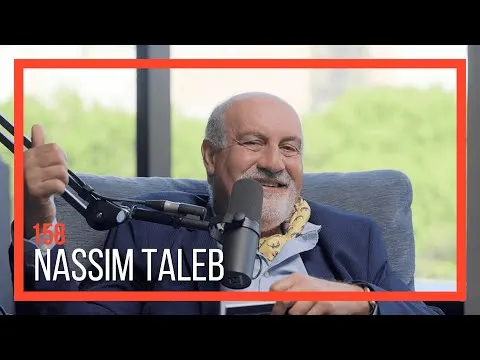
Nassim Nicholas Taleb

Nassim Nicholas Taleb

x.com/nntaleb

Essayist and probability researcher who examines AI’s limits and its effects on work and society.

Wie wird KI die Welt verändern?

Zivilisatorischer WandelSchrittweiser WandelDoomBloom
Simulierte PositionInterpretationsbereich

Horizontal: sein geäußerter Doom–Bloom-Ausblick. Vertikal: Ausmaß der Transformation.

Doom–Bloom: 17 von 100. Ausmaß der Transformation: 67 von 100. Interpretationsbereiche: horizontal 12 bis 25, vertikal 48 bis 77. Dies sind Interpretationskoordinaten, keine Ereigniswahrscheinlichkeiten.

P(doom) von Nassim Nicholas Taleb · abgeleitet

≈4%

0%100%

Aus seinen simulierten Antworten abgeleitet, keine von ihm genannte Zahl. Plausibler Bereich: 3–9%.

Wie wir P(doom) schätzen

Zeithorizont für Meilensteine von Nassim Nicholas Taleb
  1. Arbeit und Institutionen

    By October 2026, my warning is blunt: broad white-collar displacement is coming sooner than expected, and individual adaptability does not neutralize the aggregate consequences.

    Antwort 1

Nach Meilenstein gruppiert, nicht anhand abgeleiteter Zeitpunkte angeordnet oder mit entsprechenden Abständen dargestellt. Für AGI und übermenschliche KI gelten weiterhin seine Definitionen.

Wovon seine Einschätzung abhängt

Eine zentrale Annahme

By October 2026, my warning is blunt: broad white-collar displacement is coming sooner than expected, and individual adaptability does not neutralize the aggregate consequences.
Antwort 1

Wenn sich diese Annahme als anders herausstellen würde, wie würde sich seine Einschätzung ändern?

Eine ungeklärte Frage

I don’t have a defensible numerical probability.
Antwort 3

Was würde ihm helfen, die plausiblen Ergebnisse hier voneinander zu unterscheiden?

Was ihre Meinung ändern könnte

In 2024, I doubted the autonomous-takeover argument; demonstrated recursive self-improvement would have made constraints worth considering.
Antwort 3

Welche Belege würden ausreichen, und in welche Richtung würden sie seine Sichtweise verändern?

Weitere Details

Erwartete Vorteile

Mehrere Lesarten bleiben plausibel: Es werden begrenzte oder eng verteilte Vorteile erwartet. / Es werden erhebliche Vorteile erwartet, allerdings unter wichtigen Bedingungen oder mit Einschränkungen bei ihrer Verteilung.

48 / 100

Geringe AuswirkungenTransformative Auswirkungen

Interpretationsbereich von 33 bis 67 auf der qualitativen Skala.

Erwartete Schäden

Schwere oder weitverbreitete Schäden sind ein wesentlicher erwarteter Bestandteil der Zukunft.

67 / 100

Geringe AuswirkungenTransformative Auswirkungen

Interpretationsbereich von 67 bis 67 auf der qualitativen Skala.

Menschlicher Einfluss

Eine vorläufige Schätzung auf Grundlage deiner Antworten; der breitere Bereich zeigt andere plausible Deutungen.

48 / 100

Geringer EinflussStarker Einfluss

Interpretationsbereich von 0 bis 100 auf der qualitativen Skala.

Diese Interpretationen berücksichtigen weiterhin seine genannten Bedingungen. Vorteile und Schäden können beide erheblich sein. Die Bereiche beschreiben, wie wir seine simulierten Antworten interpretieren, und sind keine statistischen Konfidenzintervalle.

Wo stehst du im Vergleich zu Nassim Nicholas Taleb?
Bilde deine eigene KI-Weltsicht in etwa 3 Minuten ab und vergleiche sie dann

Ähnliche Weltsichten

Vordenker, deren simulierte Weltsichten der von Nassim Nicholas Taleb am nächsten kommen

Was Nassim Nicholas Taleb über KI gesagt hat

Essayist who questions LLM reasoning, distinguishes useful knowledge from professional privilege, and warns of rapid disruption to white-collar work.

  1. “Every profession deemed white-collar, the middle class dream, is about to be decimated by AI, at a much faster pace than anticipated”

    X, white-collar disruption warning
  2. “Something bad for the (existing) class of mathematicians as they lose their privilege, but not necessarily bad for mathematics & our body of knowledge?”

    X, mathematicians and mathematical knowledge
  3. “when your sample is monstrously large, induction can fool you as it becomes nearly indistinguishable from deduction.”

    X, induction and deduction
  4. “You can't put constraints ahead of time on research.”

    The Joe Walker Podcast, Meditations on Extremistan

Wörtlich aus den verlinkten Quellen, geprüft am 23. Okt. 2026

Quellen

Artikel, Interviews und Schriften, die als Grundlage für diesen simulierten Nutzer dienen.

Simulierte Einschätzung

Frage 1

Was glaubst du, was KI für unsere Zukunft bedeutet – und warum?

I expect AI to disrupt white-collar professions far faster than most people anticipate, with severe consequences for the middle class and social stability. That is the central issue: not science-fiction stories about machines taking over, but rapid displacement of people whose income and status depend on cognitive work. We should separate three questions that are often confused. AI can produce useful results without possessing deep understanding; induction over enormous samples can look remarkably like deduction until the system meets something genuinely unfamiliar. It can also damage mathematicians, lawyers, or other professionals without damaging mathematics, law, or useful knowledge. Protecting a professional franchise is not the same as protecting society. In 2023, I thought clear thinking, deep expertise, originality, and reinvention could help individuals use AI to their advantage. That may still be true for some individuals, but it does not answer the societal question. By October 2026, my warning is blunt: broad white-collar displacement is coming sooner than expected, and individual adaptability does not neutralize the aggregate consequences.

Frage 2

Wie stark wird KI deiner Meinung nach letztlich die Welt verändern?

Enormously. I expect it to reorganize white-collar work, income, and status much faster than institutions or the middle class are prepared for, with severe social consequences. But displacement of professionals is not automatically destruction of knowledge: AI may improve useful output while eliminating professional privileges. Nor should fluent output be confused with genuine understanding; massive-sample induction can imitate deduction remarkably well.

Frage 3

Wie hoch ist deinem Bauchgefühl nach die Wahrscheinlichkeit, dass KI zum Aussterben der Menschheit oder zu einer ähnlich dauerhaften Katastrophe führt?

I don’t have a defensible numerical probability. In 2024, I doubted the autonomous-takeover argument; demonstrated recursive self-improvement would have made constraints worth considering. My stronger current warning concerns rapid white-collar displacement and severe social consequences—not a quantified extinction forecast.

Frage 4

Was müsste eine gute Zukunft vom Menschsein bewahren?

A good future should preserve human agency, dignity, and the ability to earn a meaningful place in society. Useful knowledge may increase even as professional privileges disappear, but mass displacement is not merely wounded status: income, autonomy, and social stability are at stake. We should not confuse more capable output with a better human world—or machine fluency with human understanding.
Wo stehst du?
Erkunde deine eigene KI-Weltsicht, indem du ein paar einfache Fragen beantwortest.
Deine eigene Weltsicht abbilden