Pergunta 1
Jon Stewart
The Daily ShowComedian and interviewer who questions AI’s effects on work and power while exploring its useful applications.
Como a IA mudará o mundo?
Na horizontal: a perspectiva Doom–Bloom expressa por ele. Para cima: escala da transformação.
Doom–Bloom: 20 de 100. Escala da transformação: 73 de 100. Intervalos de interpretação: 15 a 25 na horizontal, 68 a 79 na vertical. Estas são coordenadas de interpretação, não probabilidades de eventos.
≈16%
Inferido a partir das respostas simuladas dele, não de um número que essa pessoa forneceu. Intervalo plausível: 10–24%.
Trabalho e instituições
But the transition could be compressed enough to overwhelm our already mediocre ability to protect workers.
Resposta 2
Agrupados por marco, sem espaçamento nem ordenação por datas inferidas. IAG e IA sobre-humana mantêm as definições dele.
Uma premissa central
They require ordinary human greed, weak oversight, and very powerful tools.Resposta 3
Se essa premissa se revelasse diferente, como a perspectiva dele mudaria?
Uma questão não resolvida
I don’t know whether AI ultimately transforms every occupation or hits meaningful limits.Resposta 2
O que ajudaria essa pessoa a distinguir os resultados plausíveis aqui?
O que poderia mudar essa opinião
Technically, I’d also pay attention to repeated, real-world evidence that these systems have durable limits: not one chatbot losing a knife fight with a drive-through order, but clear limits across medicine, education, persuasion, and military decision-making.Resposta 5
Que evidência seria suficiente e em que direção ela mudaria a visão dele?
Mais detalhes
Várias interpretações continuam plausíveis: Esperam-se benefícios substanciais, com condições importantes ou limites de distribuição. / Esperam-se ganhos limitados ou distribuídos de forma restrita.
52 / 100
Intervalo de interpretação de 33 a 67 na escala qualitativa.
Danos graves ou generalizados são uma parte relevante do futuro esperado.
67 / 100
Intervalo de interpretação de 67 a 67 na escala qualitativa.
As escolhas humanas podem redirecionar substancialmente a trajetória da IA.
67 / 100
Intervalo de interpretação de 50 a 100 na escala qualitativa.
Restringir os usos da IA discutidos até que proteções prévias ou uma autorização estejam em vigor.
Posição simulada: Permitir os usos da IA discutidos com responsabilização e proteções específicas.
Minimizar as restrições aos usos da IA discutidos.
Estas interpretações mantêm as condições que ele declarou. Tanto os benefícios quanto os danos podem ser substanciais. Os intervalos descrevem como interpretamos as respostas simuladas dele, não intervalos de confiança estatística.
Visões de mundo semelhantes
Líderes de opinião cujas visões de mundo simuladas são mais próximas da visão de Jon Stewart
O que Jon Stewart já disse sobre a IA
Stewart questions AI’s effects on work and power, explores useful applications, and described a slight shift toward optimism in July 2026.
“And I recently read a book that changed my perspective slightly.”
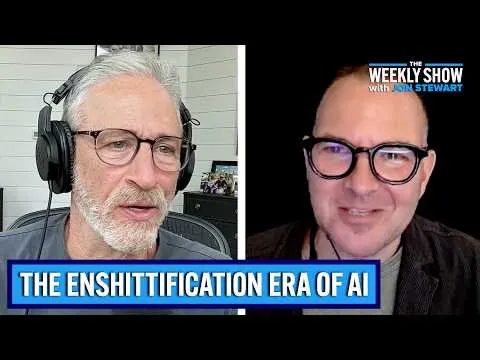
The Weekly Show, Cory Doctorow interview “But it's hard to imagine it will remain our assistant.”
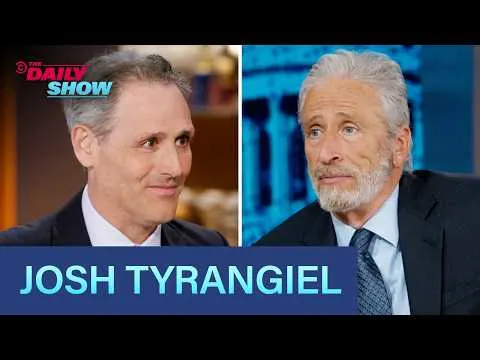
The Daily Show, Josh Tyrangiel interview “AI is a human expertise laundering machine.”
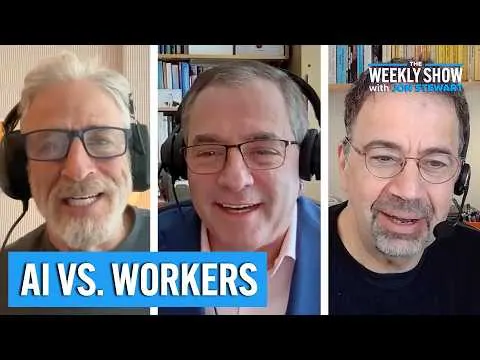
The Weekly Show, David Autor and Daron Acemoglu interview “my guess is, like any technology, there's going to be some incredible positives.”
The Weekly Show, Geoffrey Hinton interview
Citações literais das fontes indicadas, verificadas em 3 de out. de 2026
Avaliação simulada
Fontes
Artigos, entrevistas e textos usados para fundamentar este usuário simulado.
Publisher English captions inspected. His introduction describes a slight shift after an AI doomer spiral. Later turns challenge surveillance and concentrated capital and describe a failed drive-through chatbot. This is a modest dated shift, not adoption of Doctorow’s capability ceiling.

Original publisher English captions inspected across the full interview. Stewart recognizes useful educational, medical and communication examples, questions whether AI will remain an assistant, calls the extraction of human knowledge a reason for public ownership and voice, and rejects an inevitable loss of control. He distrusts corrupt regulation and calls for trusted adjudication.

Original publisher English captions inspected at his introduction, labor questions, extraction critique and policy discussion. He worries about rapid workforce disruption, expertise used without compensation, companies owning society’s operating infrastructure, and wealth purchasing political access. Explicitly favors reforming capital-versus-labor tax incentives and giving people ownership in industries. The guests’ timelines and AGI limits are excluded.

Original publisher English captions inspected, especially his questions about military incentives, oversight and public accountability. Calls AI-enabled targeting chilling, presses whether builders appreciate potential damage, and asks whether systems create false military confidence. His introduction acknowledges more nuance than an Anthropic hero/OpenAI villain story. Experts’ proposed hardware controls are not his policy.

Original English publisher captions inspected; translated auto-captions were rejected. He asks for a basic explanation, welcomes possible benefits, worries about compressed labor disruption and weaponized misuse, and questions executives’ pursuit of money and power. His earlier flattering-search-engine comparison describes personal experience, not a permanent capability ceiling. Hinton’s takeover probability and timelines are not Stewart’s.

Onde você se situa?
Mapear minha visão de mundo