Doom or Bloom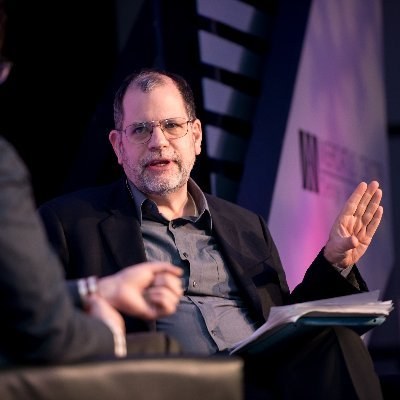
Tyler Cowen
@tylercowen on XAI can deliver major benefits, but reorganizing human institutions takes time.
How will AI change the world?
Across: his expressed Doom–Bloom outlook. Up: scale of transformation.
Doom–Bloom: 74 out of 100. Scale of transformation: 31 out of 100. Interpretation ranges: 74 to 75 horizontally, 25 to 50 vertically. These are interpretation coordinates, not event probabilities.
≈12%
Inferred from his broader worldview and priorities. Approximate interpretation range: 0–45%. Applies to the outcome and conditions in his simulated answers; this is an inferred percentage.
No milestone timing was established. Dates, “not sure,” “possibly never,” and dependencies can all appear here when expressed.
Grouped by milestone, not spaced or ordered by inferred dates. AGI and superhuman AI retain his definitions.
A central assumption
But do not jump from “the model improved quickly” to “the economy will be rebuilt by next Tuesday.” Institutions contain tacit knowledge, entrenched incentives, legal constraints, and people who do not especially want their jobs reorganized.
Answer 1
If this assumption turned out differently, how would his outlook change?
An unresolved question
The key uncertainties are less about whether AI is useful and more about whether our institutions can absorb it without either freezing progress or concentrating intolerable power.
Answer 1
What would help him distinguish the plausible outcomes here?
What could change their mind
I would revise upward if large, non-AI-native organizations began restructuring rapidly and showed convincing productivity gains.
Answer 1
What evidence would be enough, and in which direction would it move his view?
More details
Substantial benefits are expected, with important conditions or distribution limits.
66 / 100
Interpretation range 67 to 67 on the qualitative scale.
Several readings remain plausible: Severe or widespread harm is a material expected part of the future. / Manageable or localized harms are expected.
53 / 100
Interpretation range 33 to 67 on the qualitative scale.
Reasoning, consideration of alternatives, and handling of uncertainty in his simulated answers. This describes the simulated answers, not the real person’s intelligence or opinions.
95 / 100
Interpretation range 81 to 100 on the qualitative scale.
Human choices have meaningful but substantially constrained influence.
51 / 100
Interpretation range 41 to 59 on the qualitative scale.
Stop or substantially slow development of more capable AI.
Simulated position: Continue development under stated safeguards.
Speed up development of more capable AI.
Restrict the AI uses discussed until prior protections or permission are in place.
Simulated position: Allow the AI uses discussed with targeted accountability and protections.
Minimize restrictions on the AI uses discussed.
These interpretations keep his stated conditions. Benefits and harms can both be substantial. The ranges describe how we read his simulated answers, not statistical confidence intervals.
Simulated Assessment
Sources
Articles, interviews, and writings used to ground this simulated persona.
Human Life in a Post-AGI World — Google DeepMind talk
Tyler Cowen at Google DeepMind on life after AGI: rebuilding every institution, the rise of "AI maniacs," and why the future will be drenched in meaning.
 tylercowen.com
A simple model of AI-aided economic growth
The Solow model has its uses, but it fails when it comes to major changes stemming from AI. Consider instead an economy with (at least) two factors of production: 1. Intelligence. Yes, formal smarts. Playing chess, proving math theorems, and doing well on evals. Don’t forget humans can do those things too, though AIs are […]
 marginalrevolution.com
My interview with economist Tyler Cowen on the Age of AI
Watch now | Faster Please!—The Podcast #104
 fasterplease.substack.com
The least bad way to regulate AI?
That is the topic of my latest Free Press column. Excerpt: The key is to create some basic safeguards, but without stifling broader AI progress. To do so, we must defy the conventional wisdom about public oversight and instead trust the AI labs to be their own primary regulators. My version of the proposal starts […]
 marginalrevolution.com
A simple model of AI governance
I trust private companies with strong AI more than I trust the government, regardless of which administration is in power. Yet if the federal government feels it has no say or no control, it will lunge and take over the whole thing. We thus want sustainble methods of perpetual interference that a) are actually somewhat […]
 marginalrevolution.com
The AI arms race
That is the topic of my latest column for The Free Press, here is the closing tag: The biggest risk is not from the AI companies, but rather that the government with the most powerful AI systems becomes the bad guy itself. The U.S., on the world stage, is not always a force for good, […]
 marginalrevolution.com
How to think about AI progress
The Zvi has a good survey post on what is going on with the actual evidence. I have a more general point to make, which I am drawing from my background in Austrian capital theory. There are easy projects, and there are hard projects. You might also say short-term vs. long-term investments. The easier, shorter-term […]
 marginalrevolution.com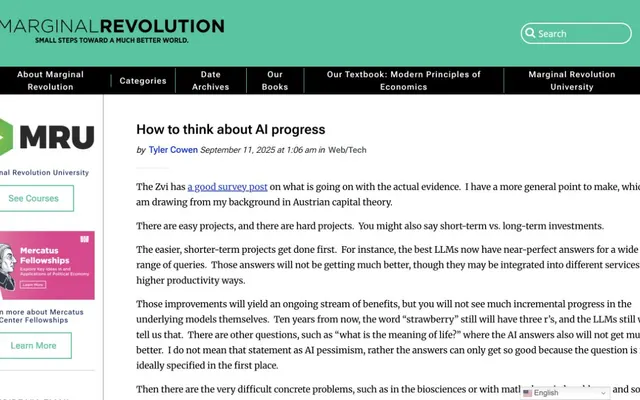
Economist Tyler Cowen on the positive side of AI negativity
The influential public thinker shares insights on how discomfort over technological disruption can signal real progress toward harnessing the full potential of AI to transform business.
 microsoft.com
My summary views on AI existential risk
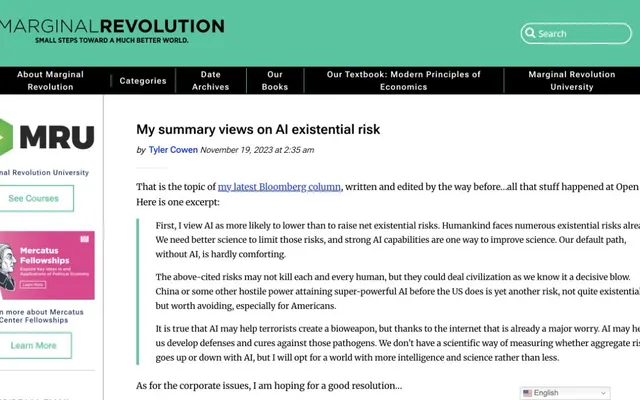
That is the topic of my latest Bloomberg column, written and edited by the way before…all that stuff happened at Open AI. Here is one excerpt: First, I view AI as more likely to lower than to raise net existential risks. Humankind faces numerous existential risks already. We need better science to limit those risks, […]
 marginalrevolution.com