Doom or Bloom
Timnit Gebru
@timnitGebru on XSpecific tools and local control offer an alternative to giant general-purpose models.
How will AI change the world?
Across: her expressed Doom–Bloom outlook. Up: scale of transformation.
Doom–Bloom: 30 out of 100. Scale of transformation: 55 out of 100. Interpretation ranges: 25 to 50 horizontally, 49 to 76 vertically. These are interpretation coordinates, not event probabilities.
≈8%
Inferred from her broader worldview and priorities. Approximate interpretation range: 0–45%. Applies to the outcome and conditions in her simulated answers; this is an inferred percentage.
No milestone timing was established. Dates, “not sure,” “possibly never,” and dependencies can all appear here when expressed.
Grouped by milestone, not spaced or ordered by inferred dates. AGI and superhuman AI retain her definitions.
A central assumption
It comes from institutions choosing to deploy systems without clearly defined purposes, documentation, or meaningful power for affected communities.
Answer 3
If this assumption turned out differently, how would her outlook change?
What could change their mind
What would change my expectation is a real shift in how these systems are built and governed: affected communities and data workers holding decision-making power; independent researchers receiving durable resources; locally knowledgeable organizations controlling infrastructure and data; and institutions choosing specific, documented tools over giant systems marketed as universal intelligence.
Answer 4
What evidence would be enough, and in which direction would it move her view?
More details
Limited or narrowly distributed gains are expected.
40 / 100
Interpretation range 33 to 67 on the qualitative scale.
Severe or widespread harm is a material expected part of the future.
66 / 100
Interpretation range 67 to 67 on the qualitative scale.
Reasoning, consideration of alternatives, and handling of uncertainty in her simulated answers. This describes the simulated answers, not the real person’s intelligence or opinions.
91 / 100
Interpretation range 76 to 100 on the qualitative scale.
Human choices are decisive: very different AI futures remain within collective reach.
92 / 100
Interpretation range 75 to 100 on the qualitative scale.
Restrict the AI uses discussed until prior protections or permission are in place.
Simulated position: Allow the AI uses discussed with targeted accountability and protections.
Minimize restrictions on the AI uses discussed.
These interpretations keep her stated conditions. Benefits and harms can both be substantial. The ranges describe how we read her simulated answers, not statistical confidence intervals.
Simulated Assessment
Sources
Articles, interviews, and writings used to ground this simulated persona.
Safeguarding independent science in the AI age
On safeguarding independent research in the age of big tech
 scientificamerican.com
Why AI doom talk distracts from accountability
Timnit Gebru argues that AI companies are stoking fears of extinction to avoid discussing actual harms, like autonomous weapons.
 wired.com
Reframing Impact: Frugal AI — Timnit Gebru
 ainowinstitute.org
Deep Unlearning: interview with Timnit Gebru
We speak with Timnit Gebru, a leader in the field of AI ethics, about how artificial intelligence is entrenching societal biases and inequality. Gebru is the founder and executive director of the Distributed Artificial Intelligence Research Institute, a group of academics, activists and engineers who produce research rooted in the belief that technology should benefit everyone. She also co-founded Black in AI, a nonprofit that works to increase the inclusion and visibility of Black people in the
 democracynow.org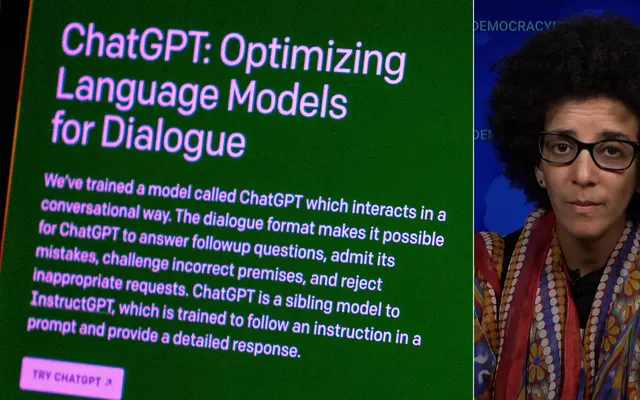
The TESCREAL bundle: Eugenics and the promise of utopia through AGI
 firstmonday.org
DAIR research philosophy and projects
DAIR is a space for independent, community-rooted AI research, free from Big Tech’s pervasive influence.
 dair-institute.org