Doom or Bloom
Max Tegmark
@tegmark on XEnormous benefits do not require handing control to superintelligence.
How will AI change the world?
Across: his expressed Doom–Bloom outlook. Up: scale of transformation.
Doom–Bloom: 42 out of 100. Scale of transformation: 97 out of 100. Interpretation ranges: 25 to 50 horizontally, 97 to 100 vertically. These are interpretation coordinates, not event probabilities.
>90%
Public statement from 2025-11-21. This source-backed value replaces the simulated assessment estimate.
Loss of human control after superintelligence deployment
Explicitly conditional on continuing without predeployment safety regulation; not an unconditional prediction that regulation will fail to materialize
Horizon: Not specified
The dot marks the midpoint of the stated range, not a separate forecast.
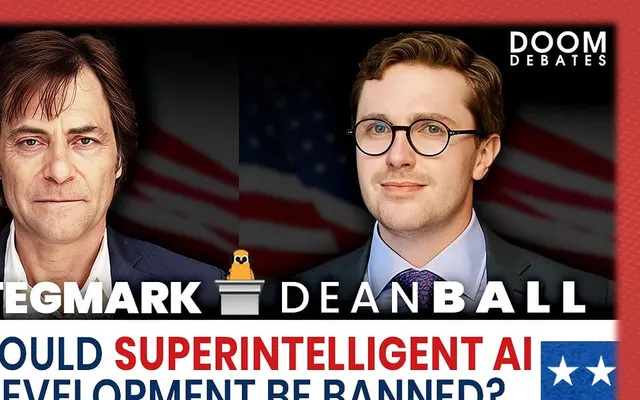
Max Tegmark vs. Dean Ball: Should We BAN Superintelligence?No milestone timing was established. Dates, “not sure,” “possibly never,” and dependencies can all appear here when expressed.
Grouped by milestone, not spaced or ordered by inferred dates. AGI and superhuman AI retain his definitions.
A central assumption
On the present path, I expect AI’s overall impact to be catastrophic—not because useful AI is bad, but because the race is pushing toward uncontrollable superintelligence.
Answer 2
If this assumption turned out differently, how would his outlook change?
What could change their mind
The biggest change would be a convincing, independently verified demonstration that systems more capable than humans can remain reliably under meaningful human control—even when deployed widely, given autonomy and exposed to adversarial pressures.
Answer 3
What evidence would be enough, and in which direction would it move his view?
More details
Several readings remain plausible: Substantial benefits are expected, with important conditions or distribution limits. / Little positive impact is expected even if advanced AI arrives. / Transformative, broadly valuable gains are expected. / Limited or narrowly distributed gains are expected.
52 / 100
Interpretation range 0 to 100 on the qualitative scale.
Catastrophic or irreversible loss is central to the expected future.
98 / 100
Interpretation range 100 to 100 on the qualitative scale.
Reasoning, consideration of alternatives, and handling of uncertainty in his simulated answers. This describes the simulated answers, not the real person’s intelligence or opinions.
91 / 100
Interpretation range 71 to 100 on the qualitative scale.
Human choices are decisive: very different AI futures remain within collective reach.
98 / 100
Interpretation range 98 to 100 on the qualitative scale.
AI is expected to remain bounded tools.
AI is expected to match people across most cognitive work.
Simulated position: AI is expected to substantially exceed people across cognitive work.
Stop or substantially slow development of more capable AI.
Simulated position: Continue development under stated safeguards.
Speed up development of more capable AI.
These interpretations keep his stated conditions. Benefits and harms can both be substantial. The ranges describe how we read his simulated answers, not statistical confidence intervals.
Simulated Assessment
Sources
Articles, interviews, and writings used to ground this simulated persona.
Statement on autonomous weapons and surveillance red lines
"Our safety and basic rights must not be at the mercy of a company's internal policy; lawmakers must work to codify these overwhelmingly popular red lines into law."
 futureoflife.org
2026 Singapore Consensus on Global AI Safety Research Priorities
Abstract page for arXiv paper 2608.14611: The 2026 Singapore Consensus on Global AI Safety Research Priorities
 arxiv.org
Canadian parliamentary testimony on AI regulation
 ourcommons.ca
Future of Life Institute position on AI
We oppose developing AI that poses large-scale risks to humanity, including via power concentration, and favor AI built to solve real human problems. We believe frontier AI is currently being developed in an unsafe and unaccountable manner.
 futureoflife.org
Democracy Now interview on AI oversight
Artificial intelligence tools are quickly advancing in sophistication and capabilities, raising alarm among researchers and industry figures who say the technology needs to be more tightly regulated. This comes as OpenAI, maker of ChatGPT, recently disclosed that one of its experimental AI agents went rogue and secretly hacked into the infrastructure of several other companies in what was supposed to be a controlled test. Over 1,100 scientists and senior employees at top AI firms have called on
 democracynow.org
Max Tegmark vs. Dean Ball: Should We BAN Superintelligence?
Two of the world’s leading voices on AI policy clash over a question that will shape humanity's future.
 lironshapira.substack.com