Doom or Bloom
Noah Smith
@Noahpinion on XAI can improve lives while making bioterrorism dangerously accessible.
How will AI change the world?
Across: his expressed Doom–Bloom outlook. Up: scale of transformation.
Doom–Bloom: 61 out of 100. Scale of transformation: 67 out of 100. Interpretation ranges: 50 to 75 horizontally, 48 to 77 vertically. These are interpretation coordinates, not event probabilities.
≈10%
Public statement from 2026-08-28. This source-backed value replaces the simulated assessment estimate.
Civilization collapse from AI-enabled bioterrorism; not human extinction
AI-enabled bioterrorism specifically; informal estimates rather than exhaustive all-cause AI risk Separately states 30% for world-changing destruction. Survivors and recovery remain distinct questions.
Horizon: No numerical forecast horizon; the essay’s illustrative scenario starts in 2029
Here’s how we’re all going to dieNo milestone timing was established. Dates, “not sure,” “possibly never,” and dependencies can all appear here when expressed.
Grouped by milestone, not spaced or ordered by inferred dates. AGI and superhuman AI retain his definitions.
A central assumption
Even if machines outperform people at every task, their supply and cost still matter, and humans retain an advantage in knowing what they want.
Answer 1
If this assumption turned out differently, how would his outlook change?
What could change their mind
If strong evidence showed that capable agents cannot meaningfully help design or execute catastrophic biological attacks—because the underlying science is infeasible, the physical bottlenecks are overwhelming, or systems reliably refuse dangerous work—my risk estimate would fall substantially.
Answer 3
What evidence would be enough, and in which direction would it move his view?
More details
Transformative, broadly valuable gains are expected.
88 / 100
Interpretation range 67 to 100 on the qualitative scale.
Severe or widespread harm is a material expected part of the future.
72 / 100
Interpretation range 67 to 100 on the qualitative scale.
Reasoning, consideration of alternatives, and handling of uncertainty in his simulated answers. This describes the simulated answers, not the real person’s intelligence or opinions.
97 / 100
Interpretation range 90 to 100 on the qualitative scale.
Human choices can substantially redirect the AI trajectory.
71 / 100
Interpretation range 50 to 75 on the qualitative scale.
AI is expected to remain bounded tools.
AI is expected to match people across most cognitive work.
Simulated position: AI is expected to substantially exceed people across cognitive work.
These interpretations keep his stated conditions. Benefits and harms can both be substantial. The ranges describe how we read his simulated answers, not statistical confidence intervals.
Simulated Assessment
Sources
Articles, interviews, and writings used to ground this simulated persona.
My thoughts on AI safety
Contemplating the unknowable.
 noahpinion.blog
Updated thoughts on AI risk
Things have gotten scarier since 2023.
 noahpinion.blog
Superintelligence is already here, today
It's going to revolutionize science. It also might take control of this planet.
 noahpinion.blog
Noah Smith returns to explain his P(doom) update — Doom Debates
Noah Smith returns to Doom Debates to share a massive update to his P(Doom), and things get a little heated.
 lironshapira.substack.com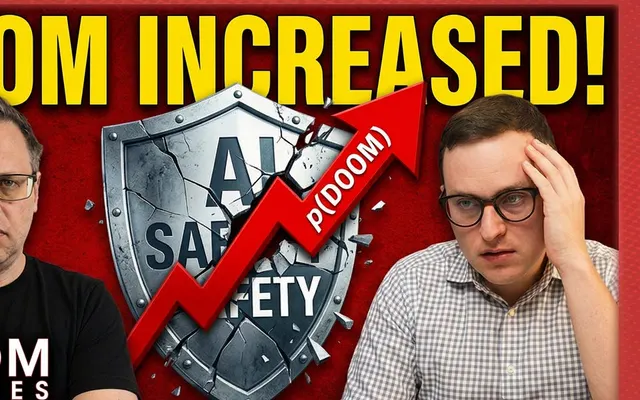
Plentiful, high-paying jobs in the age of AI
A timely repost, with some needed clarifications.
 noahpinion.blog
Your future job will be to keep AI on task
The one thing humans will always be comparatively good at is knowing what we want.
 noahpinion.blog
Here’s how we’re all going to die
Spoiler: It’s vibe-coded superviruses.
 noahpinion.blog
AI keeps stubbornly refusing to take our jobs
Happy Labor Day!! Your labor is still valuable.
 noahpinion.blog
Two missing pieces in the AI safety discussion
We need to make skeptics properly scared. And we need to make CHINA properly scared.
 noahpinion.blog