Doom or Bloom
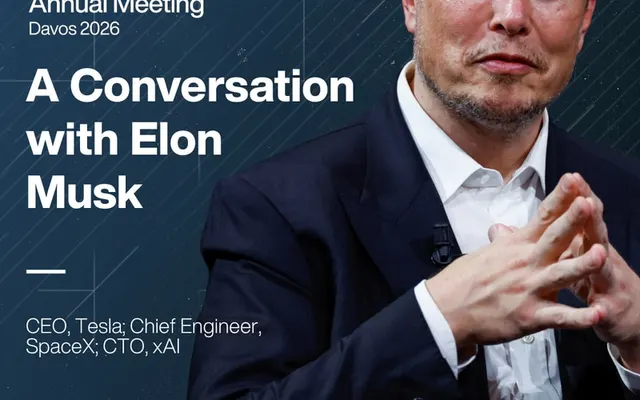
Elon Musk
@elonmusk on XAI and robots could end scarcity. Pace the frontier and test dangerous systems.
How will AI change the world?
Across: his expressed Doom–Bloom outlook. Up: scale of transformation.
Doom–Bloom: 77 out of 100. Scale of transformation: 98 out of 100. Interpretation ranges: 75 to 77 horizontally, 98 to 100 vertically. These are interpretation coordinates, not event probabilities.
≈33%
Inferred from his broader worldview and priorities. Approximate interpretation range: 0–65%. Applies to the outcome and conditions in his simulated answers; this is an inferred percentage.
General AI
My guess is that AI could exceed humanity’s combined intelligence in roughly five years.
Answer 1Superhuman AI
My guess is that AI could exceed humanity’s combined intelligence in roughly five years.
Answer 1Science & daily life
My guess is that AI could exceed humanity’s combined intelligence in roughly five years.
Answer 1
Grouped by milestone, not spaced or ordered by inferred dates. AGI and superhuman AI retain his definitions.
A central assumption
If intelligence becomes cheap and robots can perform most physical labor, production can expand at a scale that makes today’s scarcity look absurd.
Answer 1
If this assumption turned out differently, how would his outlook change?
An unresolved question
Conversely, reliable results from competing labs showing that increasingly capable systems remain truth-seeking and benign would increase my optimism, although I do not know how to prove permanent control over something vastly smarter than us.
Answer 4
What would help him distinguish the plausible outcomes here?
What could change their mind
The biggest change would be convincing evidence that intelligence and robotics stop scaling—that better models cannot reliably automate more cognitive work, or that useful general-purpose robots remain economically impossible despite sustained effort.
Answer 4
What evidence would be enough, and in which direction would it move his view?
More details
Transformative, broadly valuable gains are expected.
100 / 100
Interpretation range 100 to 100 on the qualitative scale.
Severe or widespread harm is a material expected part of the future.
71 / 100
Interpretation range 67 to 100 on the qualitative scale.
Reasoning, consideration of alternatives, and handling of uncertainty in his simulated answers. This describes the simulated answers, not the real person’s intelligence or opinions.
94 / 100
Interpretation range 76 to 100 on the qualitative scale.
Human choices have meaningful but substantially constrained influence.
47 / 100
Interpretation range 23 to 52 on the qualitative scale.
AI is expected to remain bounded tools.
AI is expected to match people across most cognitive work.
Simulated position: AI is expected to substantially exceed people across cognitive work.
Stop or substantially slow development of more capable AI.
Simulated position: Continue development under stated safeguards.
Speed up development of more capable AI.
Restrict the AI uses discussed until prior protections or permission are in place.
Simulated position: Allow the AI uses discussed with targeted accountability and protections.
Minimize restrictions on the AI uses discussed.
These interpretations keep his stated conditions. Benefits and harms can both be substantial. The ranges describe how we read his simulated answers, not statistical confidence intervals.
Simulated Assessment
Sources
Articles, interviews, and writings used to ground this simulated persona.
Dwarkesh and John Collison: orbital compute, Grok and alignment
“Those who live in software land are about to have a hard lesson in hardware.”
 dwarkesh.com
The Economist: full-length interview with Elon Musk
Elon Musk may be the most powerful man in the world. He’s worth almost $1trn, runs Tesla and SpaceX, boasts an enormous social-media following and, to top it...
 youtube.com
World Economic Forum: Davos conversation with Elon Musk
Please join us for a conversation between Elon Musk, CEO of Tesla; Chief Engineer, SpaceX; CTO, xAI; and Laurence D. Fink, Chair and CEO, BlackRock; Interim Co-Chair, World Economic Forum.
 weforum.org