Charles Goddard

Charles Goddard

x.com/chargoddard

Machine learning researcher behind the open-source model-merging toolkit MergeKit who argues open tools help researchers build on each other’s work.

AIは世界をどのように変えるでしょうか?

文明規模の変化漸進的な変化DoomBloom
シミュレーション上の位置解釈範囲

横軸:その人が表明したDoom–Bloomの見通し。 縦軸:変革の規模。

Doom–Bloom:100点中79。変革の規模:100点中37。解釈範囲:横方向は74から84、縦方向は0から63。これらは解釈上の座標であり、事象の確率ではありません。

Charles GoddardのP(doom) · 推定

≈1%

0%100%

本人が示した数値ではなく、シミュレーションされた本人の回答から推定したものです。 妥当と考えられる範囲:9%未満。

その人の見通しを左右するもの

中心的な前提

When tools, models, and experiments are publicly accessible, many researchers can test ideas, build on one another’s results, and compound progress faster than any individual or closed team could.
回答1

この前提が実際には異なると判明した場合、その人の見通しはどう変わりますか?

詳細

予想される恩恵

大きな恩恵が予想されていますが、重要な条件や分配上の制約があります。

67 / 100

影響が小さい変革をもたらす影響

質的尺度での解釈範囲は67から67です。

人間の影響力

回答に基づく暫定的な推定です。より広い範囲は、ほかにあり得る解釈を示しています。

61 / 100

影響力が小さい影響力が大きい

質的尺度での解釈範囲は23から100です。

これらの解釈では、その人が示した条件が維持されています。恩恵と害は、どちらも大きくなり得ます。この範囲は、統計的な信頼区間ではなく、その人のシミュレーションされた回答をどのように読み取ったかを示すものです。

あなたはCharles Goddardと比べてどの位置でしょうか?
約3分で自分のAIに対する世界観をマッピングして、比較できます

似ている世界観

シミュレーションされた世界観がCharles Goddardの世界観に最も近いオピニオンリーダー

シミュレーション評価

質問1

AIは私たちの未来にとって何を意味すると思いますか?また、なぜそう思いますか?

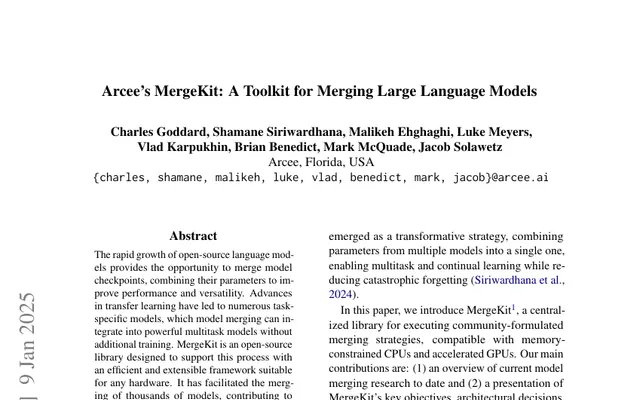
I think AI can make useful capabilities much more accessible, provided we turn research into practical, open tools. One promising path is model merging: combining capabilities learned by different models without retraining everything from scratch or necessarily increasing model size. That can produce models that are smaller, cheaper to deploy, and better suited to particular tasks. The openness matters as much as the technique. When tools, models, and experiments are publicly accessible, many researchers can test ideas, build on one another’s results, and compound progress faster than any individual or closed team could. It also lets useful AI knowledge reach people outside corporate firewalls. That does not mean every merge preserves every capability, or that optimization is free. Straightforward merges may be feasible on modest hardware, while evolutionary searches can require substantial GPU computation. The future I’m working toward is therefore not just “bigger models,” but better reuse: explicitly measuring what is preserved or lost, exposing the hardware and optimization trade-offs, and making the resulting methods usable by a broad research community.

質問2

Taking benefits and harms together, what overall impact do you expect AI to have?

Overall, I expect AI to have a positive impact, especially if useful capabilities become cheaper and more broadly accessible rather than remaining concentrated behind corporate firewalls. Open tools allow many researchers to reproduce experiments, find weaknesses, and compound improvements. Techniques such as model merging can also reuse learned capabilities without requiring full retraining or a larger model, reducing deployment costs and making specialized systems more practical. That expectation is not a claim that every model or merge is beneficial. Merging can degrade or erase capabilities, and optimization can shift costs rather than eliminate them—for example, an ordinary merge may run on modest hardware while evolutionary search requires substantial GPU resources. So the impact depends heavily on whether we test what models preserve and lose, report those trade-offs clearly, and turn emerging research into tools others can inspect and improve.

出典

このシミュレーション対象者の根拠として使用された記事、インタビュー、著作です。

あなたはどの位置でしょうか?
いくつかの簡単な質問に答えて、自分のAIに対する世界観を探ってみましょう。
自分の世界観をマッピングする

あなたはどの位置でしょうか?

自分の世界観をマッピングする