Victor Taelin

Victor Taelin

x.com/victortaelin

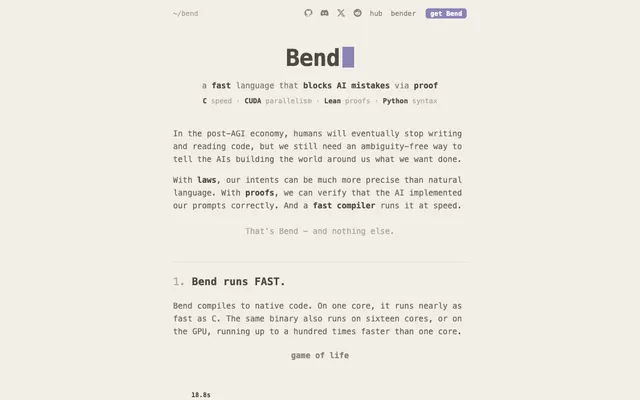
Programmer behind the Bend language who argues machine-checked proofs can catch AI coding mistakes as people read less of the code.

Comment l’IA changera-t-elle le monde ?

Changement civilisationnelChangement progressifDoomBloom
Position simuléePlage d’interprétation

Horizontalement : leur perspective Doom–Bloom telle qu’elle a été exprimée. Verticalement : ampleur de la transformation.

Doom–Bloom : 73 sur 100. Ampleur de la transformation : 40 sur 100. Plages d’interprétation : de 68 à 78 horizontalement, de 0 à 79 verticalement. Il s’agit de coordonnées d’interprétation, et non de probabilités d’événements.

P(doom) de Victor Taelin · inféré

≈3%

0%100%

Déduit de leurs réponses simulées, et non d’un chiffre donné par ces personnes. Plage plausible : 1–9%.

Ce dont dépend leur perspective

Une hypothèse centrale

But that benefit depends on reliability.
Réponse 2

Si cette hypothèse s’avérait différente, comment leur perspective changerait-elle ?

Une question non résolue

Persistent memory, precise specifications, and reliable verification together could make long-running agents far more useful—but exactly how far this extends beyond software remains uncertain.
Réponse 1

Qu’est-ce qui les aiderait à distinguer les résultats plausibles ici ?

Plus de détails

Bénéfices attendus

Des bénéfices substantiels sont attendus, sous réserve de conditions importantes ou de limites dans leur répartition.

67 / 100

Faible impactImpact transformateur

Plage d’interprétation de 67 à 67 sur l’échelle qualitative.

Dommages attendus

Des dommages gérables ou localisés sont attendus.

34 / 100

Faible impactImpact transformateur

Plage d’interprétation de 33 à 33 sur l’échelle qualitative.

Influence humaine

Les choix humains ont une influence significative, mais fortement contrainte.

54 / 100

Faible influenceForte influence

Plage d’interprétation de 29 à 96 sur l’échelle qualitative.

Ces interprétations conservent les conditions énoncées. Les bénéfices et les dommages peuvent tous deux être substantiels. Les plages décrivent notre lecture de leurs réponses simulées, et non des intervalles de confiance statistiques.

Où vous situez-vous par rapport à Victor Taelin ?
Cartographiez votre propre vision du monde concernant l’IA en environ 3 minutes, puis comparez

Visions du monde similaires

Leaders d’opinion dont les visions du monde simulées sont les plus proches de celle de Victor Taelin

Évaluation simulée

Question 1

Selon vous, que signifie l’IA pour notre avenir, et pourquoi ?

I think AI will increasingly write and maintain software at a scale where humans simply won’t read most of the code. That changes the central question from “Does this implementation look reasonable?” to “Can we state precisely what it must do, and can a machine verify that it does it?” Formal laws and machine-checked proofs are promising because they can express intent without the ambiguity of prose and prevent specified classes of mistakes from accumulating as agents work. The emphasis is on specified classes. A proof does not magically capture every human intention, eliminate every possible bug, or remove trust from the proof machinery itself. Critical kernels still deserve careful human attention, even if the surrounding agent-generated code has rough edges. I also think we should judge AI systems less by their most impressive demonstrations and more by their destructive failures. A model that occasionally produces brilliant code but sometimes corrupts a project may be less useful than one with a lower peak and a safer worst case. And those comparisons are domain-dependent: the “best” model in one programming setting may not be best elsewhere. Persistent memory, precise specifications, and reliable verification together could make long-running agents far more useful—but exactly how far this extends beyond software remains uncertain.


Question 2

Taking benefits and harms together, what overall impact do you expect AI to have?

Overall, I expect AI to be strongly beneficial, especially by expanding how much software and research we can produce. But that benefit depends on reliability. If agents generate vast amounts of code while occasionally causing destructive failures or silently accumulating technical debt, impressive peak capability is not enough. The promising path is to pair capable agents with persistent memory, precise specifications, formal laws, and machine-checked proofs. That lets us prevent defined categories of mistakes even when humans no longer read most implementations. It does not guarantee that our specification captures every intention, nor does it remove the need to scrutinize trusted kernels and proof machinery. So my expectation is positive, but not because raw capability automatically produces good outcomes. It is positive insofar as we build systems whose worst cases are controlled and whose intended properties can be stated and verified. How well that approach generalizes beyond programming is much less certain.

Sources

Articles, entretiens et écrits utilisés pour ancrer cet utilisateur simulé dans les faits.

Où vous situez-vous ?
Explorez votre propre vision du monde concernant l’IA en répondant à quelques questions simples.
Cartographiez votre propre vision du monde

Où vous situez-vous ?

Cartographier ma vision du monde