Andrej Karpathy

Andrej Karpathy

x.com/karpathy

Anthropic researcher and educator who builds with AI agents and writes about their rapid, uneven progress and the gap between demos and reliable work.

¿Cómo cambiará la IA el mundo?

Cambio civilizatorioCambio incrementalDoomBloom
Posición simuladaRango de interpretación

Horizontal: su perspectiva Doom–Bloom expresada. Vertical: escala de la transformación.

Doom–Bloom: 75 de 100. Escala de la transformación: 66 de 100. Rangos de interpretación: de 70 a 80 en horizontal y de 50 a 75 en vertical. Son coordenadas de interpretación, no probabilidades de eventos.

P(doom) de Andrej Karpathy · inferido

≈6%

0%100%

Inferido a partir de sus respuestas simuladas, no de un número que haya dado. Rango plausible: 3–13%.

De qué depende su perspectiva

Un supuesto central

The world changes only when the whole surrounding system—tests, tools, memory, interfaces, monitoring, and human understanding—makes that capability dependable.
Respuesta 2

Si este supuesto resultara distinto, ¿cómo cambiaría su perspectiva?

Una pregunta sin resolver

I don’t have a defensible percentage.
Respuesta 3

¿Qué le ayudaría a distinguir aquí entre los desenlaces plausibles?

Qué podría hacer cambiar de opinión

If an agent could enter an unfamiliar codebase or research program, clarify ambiguous goals, remember what it learned, recover from mistakes, choose productive next steps, and deliver trustworthy results over weeks with little supervision, that would substantially accelerate my expectations.
Respuesta 5

¿Qué evidencia bastaría y en qué dirección movería su visión?

Más detalles

Beneficio esperado

Se esperan beneficios sustanciales, con condiciones importantes o límites en su distribución.

75 / 100

Poco impactoImpacto transformador

Rango de interpretación de 67 a 100 en la escala cualitativa.

Daño esperado

Se esperan daños manejables o localizados.

32 / 100

Poco impactoImpacto transformador

Rango de interpretación de 0 a 33 en la escala cualitativa.

Influencia humana

Las decisiones humanas tienen una influencia significativa, aunque muy condicionada.

55 / 100

Poca influenciaInfluencia fuerte

Rango de interpretación de 48 a 77 en la escala cualitativa.

Ritmo de desarrollo

Detener o frenar considerablemente el desarrollo de IA más capaz.

Posición simulada: Continuar el desarrollo con las salvaguardas indicadas.

Acelerar el desarrollo de IA más capaz.

Reglas para usar la IA

Restringir los usos de la IA mencionados hasta que existan protecciones o permisos previos.

Posición simulada: Permitir los usos de la IA mencionados con rendición de cuentas y protecciones específicas.

Reducir al mínimo las restricciones a los usos de la IA mencionados.

Estas interpretaciones conservan las condiciones que se indicaron. Los beneficios y los daños pueden ser considerables a la vez. Los rangos describen cómo leemos sus respuestas simuladas, no intervalos de confianza estadísticos.

¿Dónde te ubicas frente a Andrej Karpathy?
Mapea tu propia visión de la IA en unos 3 minutos y luego compárala

Visiones similares

Líderes de opinión cuyas visiones simuladas son las más cercanas a la de Andrej Karpathy

Lo que Andrej Karpathy ha dicho sobre la IA

Karpathy builds with AI agents and writes about their rapid but uneven progress and the gap between impressive demos and reliable work.

  1. “When you hand a computer terminal to one of these models, you can now watch them melt programming problems that you’d normally expect to take days/weeks of work.”

    Post on X
  2. “I’ve never felt this much behind as a programmer. The profession is being dramatically refactored as the bits contributed by the programmer are increasingly sparse and between.”

    Post on X
  3. “LLMs are emerging as a new kind of intelligence, simultaneously a lot smarter than I expected and a lot dumber than I expected.”

    Essay, 2025 LLM Year in Review
  4. “My personal big fear is that a lot of this stuff happens on the side of humanity, and that humanity gets disempowered by it.”

    Dwarkesh Podcast
  5. “In my mind, this is more accurately described as the decade of agents.”

    Dwarkesh Podcast

Citas textuales de las fuentes enlazadas, comprobadas el 3 oct 2026

Evaluación simulada

Pregunta 1

¿Qué crees que significa la IA para nuestro futuro y por qué?

I think AI means a fairly profound shift in how we do intellectual work. Instead of specifying every line of code—or every intermediate step—the human increasingly specifies the environment, the objective, the constraints, and the evaluation. Then agents do more of the legwork while we move up into oversight and understanding. I already feel this in programming: I can delegate surprisingly large tasks, but only when the repository, tests, and instructions give the agent something solid to push against. The important caveat is that intelligence is extremely jagged. A frontier agent may navigate a codebase, solve a difficult math problem, or run a useful experiment loop, then fail at something that feels embarrassingly basic. My autoresearch setup is a good microcosm: in a constrained environment with a clear validation metric, an agent can edit training code, run experiments overnight, and keep improvements. That is genuinely useful. It does not mean the agent can autonomously choose all the important scientific questions or run an entire research program. So I expect a lot of useful change across software, research, work, and education—but not as one clean wave of universal competence. The magical demo is the beginning, not the product. Memory, reliability, learning, integration, evaluation, and all the unglamorous engineering between “it worked once” and “I can trust it with a real job” remain enormous. That gap is exactly why this is such an exciting time to build.

Pregunta 2

¿Cuánto crees que la IA acabará cambiando el mundo?

A lot—probably at the level of a new computing paradigm. Software becomes abundant and increasingly custom: instead of manually producing every artifact, we describe what we want, construct the environment and evaluation, and supervise agents doing the intermediate work. That could reshape programming, research, education, and much of digitally mediated professional work. But “a lot” does not mean uniformly or overnight. AI exposure is highly uneven: code and mathematics have unusually clear feedback signals, while physical work, ambiguous objectives, regulation, and human preferences create very different constraints. Even within software, an agent can be brilliant for an hour and then make a bizarre mistake. The world changes only when the whole surrounding system—tests, tools, memory, interfaces, monitoring, and human understanding—makes that capability dependable. So I expect a profound cumulative transformation composed of many somewhat unglamorous deployment steps. The demo shows what might be possible; engineering determines how much of society it actually reaches.

Pregunta 3

¿Cuál es tu estimación intuitiva de la probabilidad de que la IA cause la extinción humana o una catástrofe permanente similar?

I don’t have a defensible percentage. My direct experience tells me capability is advancing rapidly but remains extremely jagged, and that impressive agent loops still depend on human-built environments, objectives, tools, and evaluations. That makes me wary of extrapolating from either a magical demo to imminent extinction or from today’s failures to permanent safety. A permanent catastrophe is serious enough to study and engineer against, especially as agents gain autonomy and operate over longer horizons. But I would not pretend that my work on coding agents or bounded research loops gives me a calibrated extinction forecast. Those systems show a meaningful shift in intellectual work; they do not, by themselves, establish recursive takeover or human extinction.

Pregunta 4

¿Cómo esperas que las personas e instituciones que desarrollan IA respondan a sus riesgos?

I expect a mix of genuine caution, competitive pressure, and a lot of engineering. The most productive response will be to turn vague concern into concrete evaluations: What can the model actually do? Where does it fail? Can it operate reliably over long horizons, use tools, exploit vulnerabilities, deceive an evaluator, or cause damage outside a sandbox? Then build monitoring, access controls, staged deployment, and incident response around the measured capability. Institutions will be uneven, because incentives are uneven. Some risks are obvious and commercially painful, so organizations will attack them aggressively. Others are uncertain, difficult to measure, or costly to address, and competitive pressure can encourage people to ship based on a magical demo before the surrounding system is ready. Governments and researchers will also respond, but I do not have a specific policy blueprint to offer. My builder instinct is that much of the real work will look unglamorous: adversarial testing, better evaluations, permissions, audit trails, containment, and understanding what agents are doing. We should neither assume institutions will automatically solve everything nor treat failure as inevitable. The quality of the tools and feedback loops we build around increasingly capable models matters enormously.

Pregunta 5

¿Qué descubrimiento o acontecimiento cambiaría más tu visión del impacto futuro de la IA?

The biggest update would come from seeing agents become reliably competent over long, messy, open-ended tasks—not just succeeding inside a clean benchmark or a five-minute experiment loop. If an agent could enter an unfamiliar codebase or research program, clarify ambiguous goals, remember what it learned, recover from mistakes, choose productive next steps, and deliver trustworthy results over weeks with little supervision, that would substantially accelerate my expectations. Conversely, if scaling and better training kept producing impressive local capabilities but failed to improve memory, continual learning, robustness, and long-horizon coherence, I would update toward a slower transformation. The key event is not another dazzling one-shot demo. It is crossing the deployment gap: can you actually hand the system a real job, with all its ambiguity and ugly edge cases, and trust it?

Fuentes

Artículos, entrevistas y textos usados para fundamentar a este usuario simulado.

US Job Market Visualizer

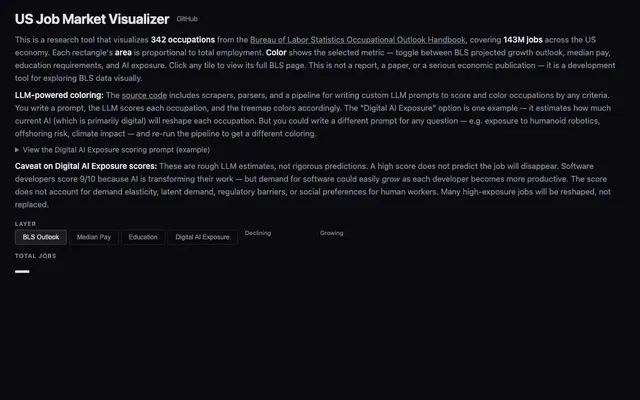
Interactive exploration of 342 BLS occupations covering 143 million US jobs, with layers for employment outlook, pay, education and digital AI exposure. Its customizable LLM scoring pipeline illustrates uneven exposure across digital and physical work. Exposure scores are rough estimates of occupational change, not predictions of job disappearance; they omit demand responses, regulatory barriers and preferences for human workers. The project explicitly describes itself as a development tool rather than a rigorous economic publication.

karpathy.ai
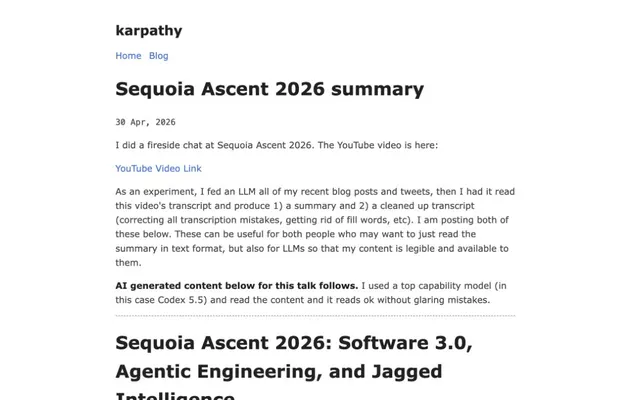
Sequoia Ascent 2026: agentic engineering and jagged intelligence

Author-posted, AI-cleaned summary and transcript, which Karpathy says he read. Describes a late-2025 jump in coding-agent usefulness, professional orchestration and evaluation, and verifiability as an explanation for uneven progress. Current enthusiasm updates the older decade-of-agents interview; the edited text is not an exact quotation transcript.

karpathy.bearblog.dev
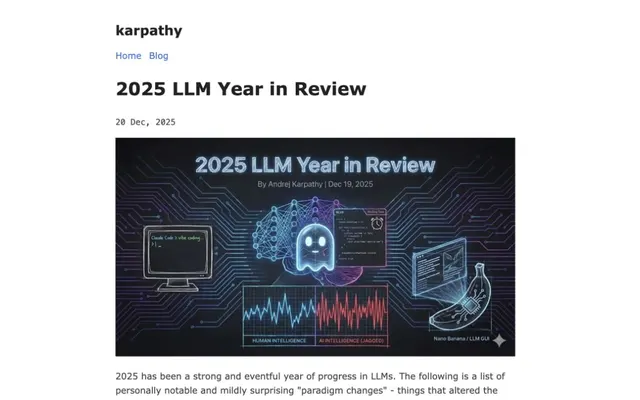
2025 LLM Year in Review

His review connects verifiable rewards to reasoning gains, criticizes benchmark overfitting, describes jagged intelligence and the growing application layer around models. Provides concrete mechanisms and builder vocabulary rather than a universal intelligence forecast.

karpathy.bearblog.dev
AGI is still a decade away

Karpathy’s primary interview frames agents as a decade of engineering work. Discusses cognitive deficits, continual learning, the gap between self-driving demos and deployment, and education. The forecast is dated and intuitive, not a calibrated deadline.

dwarkesh.com
autoresearch: autonomous single-GPU experiments

His README demonstrates agents editing a training file, running five-minute experiments and retaining improvements against a fixed validation metric. The introduction’s future agent civilization is playful fiction, not a report of current events. Human-authored instructions and a bounded setup remain essential.

github.com
¿Dónde te ubicas?
Explora tu propia visión de la IA respondiendo unas pocas preguntas sencillas.
Mapea tu propia visión de la IA

¿Dónde te ubicas?

Mapear mi visión de la IA