






Julia Galef

Julia Galef

x.com/juliagalef

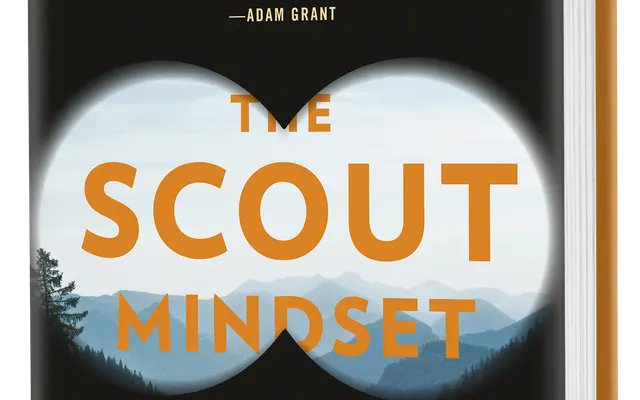
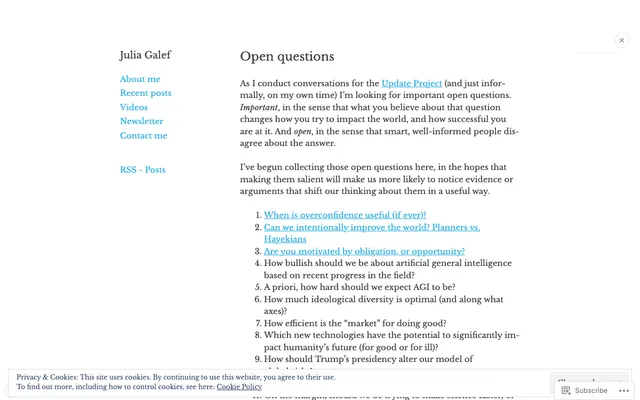
Author of “The Scout Mindset” who writes about reasoning well and changing one’s mind, and has explored why people disagree about advanced AI.

¿Cómo cambiará la IA el mundo?

Cambio civilizatorioCambio incrementalDoomBloom
Centro del rango sin resolverRango de interpretación

Horizontal: su perspectiva Doom–Bloom expresada. Vertical: escala de la transformación.

Doom–Bloom: 50 de 100. Escala de la transformación: 50 de 100. Rangos de interpretación: de 45 a 55 en horizontal y de 0 a 100 en vertical. Son coordenadas de interpretación, no probabilidades de eventos.

P(doom) de Julia Galef

Aún sin estimar

Sus respuestas simuladas no dicen lo suficiente sobre el riesgo catastrófico para estimarlo.

Cómo estimamos P(doom)

De qué depende su perspectiva

Una pregunta sin resolver

I don’t have a confident overall forecast.
Respuesta 1

¿Qué le ayudaría a distinguir aquí entre los desenlaces plausibles?

Más detalles

Influencia humana

Aún no te has decidido sobre esto. El punto marca el centro del rango abierto, no una creencia moderada.

50 / 100

Poca influenciaInfluencia fuerte

Rango de interpretación de 0 a 100 en la escala cualitativa.

Estas interpretaciones conservan las condiciones que se indicaron. Los beneficios y los daños pueden ser considerables a la vez. Los rangos describen cómo leemos sus respuestas simuladas, no intervalos de confianza estadísticos.

¿Dónde te ubicas frente a Julia Galef?
Mapea tu propia visión de la IA en unos 3 minutos y luego compárala

Visiones similares

Los líderes de opinión más cercanos a la visión simulada de Julia Galef en las pocas posturas que expresa

Fuentes

Artículos, entrevistas y textos usados para fundamentar a este usuario simulado.

Evaluación simulada

Pregunta 1

¿Qué crees que significa la IA para nuestro futuro y por qué?

I don’t have a confident overall forecast. The key questions are still how difficult AGI is, how much recent progress should update our expectations, and what models drive disagreement about the consequences of systems that surpass human capabilities. Before jumping to optimism, doom, or a policy conclusion, I’d want to identify the real cruxes. Are people disagreeing about scaling, bottlenecks in reasoning, the feasibility of controlling highly capable systems, or the institutions governing deployment? What observations would change each side’s mind? “AI means progress” and “AI means catastrophe” can both function more like team slogans than forecasts unless we unpack the mechanisms behind them. So my strongest view is methodological: we should treat confidence as something to earn through investigation, calibration, and serious engagement with disagreement. The future could depend enormously on AI, but that importance makes careful reasoning more necessary, not less.

Pregunta 2

¿Cuál es tu estimación intuitiva de la probabilidad de que la IA cause la extinción humana o una catástrofe permanente similar?

I don’t have a defensible numerical estimate. Giving a gut percentage would suggest more calibration than I can justify. I’d first want to resolve—or at least better understand—the main cruxes: how likely broadly superhuman systems are, what capabilities imply about control, and whether institutions can respond before failures become irreversible. The magnitude of the possible harm makes the question important, but it doesn’t by itself determine the probability.

Pregunta 3

¿Qué daños importantes, si los hay, esperas que cause la IA?

I don’t have a well-supported forecast of which major harms AI will actually cause. Plausible concerns range from misuse and institutional failures to loss of control over systems that become broadly more capable than humans, but listing scenarios is not the same as assigning them high probability. I’d want to separate several questions: What capabilities are likely to emerge? Who will have access to them? Which failures are reversible, and which could become permanent? How much warning would we get, and could institutions respond in time? The most useful debate would identify where people’s models diverge and what evidence would update them, rather than treating either reassurance or catastrophe as the default conclusion.

Pregunta 4

¿Qué beneficios importantes, si los hay, esperas que las personas obtengan de la IA?

AI could plausibly accelerate scientific discovery, improve decision-making, and make valuable expertise more widely available. But those are potential benefits, not a confident forecast about what people will actually receive. I’d want to distinguish capability from distribution and outcomes. A system may become excellent at research, education, or medicine without its gains being broadly shared—or without institutions using it well. The key questions are which tasks AI can reliably perform, how humans and organizations adapt, who controls access, and what evidence would show that apparent progress is translating into durable human welfare. I’m optimistic about the range of possible benefits, but I don’t think that alone justifies a confident overall prediction.
¿Dónde te ubicas?
Explora tu propia visión de la IA respondiendo unas pocas preguntas sencillas.
Mapea tu propia visión de la IA

¿Dónde te ubicas?

Mapear mi visión de la IA