






Jack Morris

Jack Morris

x.com/jxmnop

Language model researcher who studies memorization and privacy leaks from text embeddings and writes about reinforcement learning and synthetic data.

Wie wird KI die Welt verändern?

Zivilisatorischer WandelSchrittweiser WandelDoomBloom
Mitte des ungeklärten BereichsInterpretationsbereich

Horizontal: deren geäußerter Doom–Bloom-Ausblick. Vertikal: Ausmaß der Transformation.

Doom–Bloom: 47 von 100. Ausmaß der Transformation: 50 von 100. Interpretationsbereiche: horizontal 42 bis 52, vertikal 0 bis 100. Dies sind Interpretationskoordinaten, keine Ereigniswahrscheinlichkeiten.

P(doom) von Jack Morris · abgeleitet

≈8%

0%100%

Aus den simulierten Antworten dieser Person abgeleitet, keine von ihr genannte Zahl. Plausibler Bereich: 3–19%.

Wie wir P(doom) schätzen

Wovon deren Einschätzung abhängt

Eine zentrale Annahme

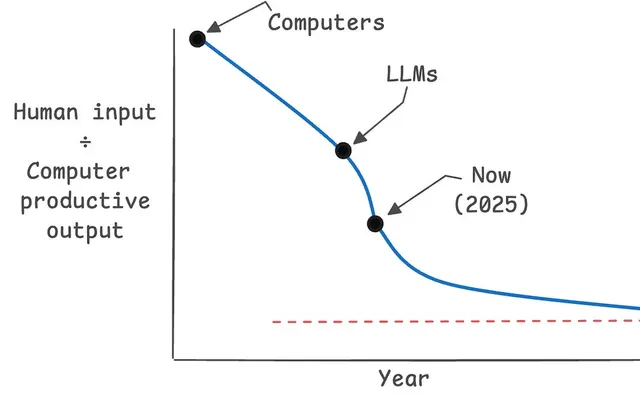
The key variable for me is how much useful output systems can produce per unit of human input, especially as that input approaches zero.
Antwort 2

Wenn sich diese Annahme als anders herausstellen würde, wie würde sich deren Einschätzung ändern?

Eine ungeklärte Frage

So I expect major change, with the ultimate magnitude still unresolved.
Antwort 3

Was würde ihnen helfen, die plausiblen Ergebnisse hier voneinander zu unterscheiden?

Weitere Details

Erwartete Vorteile

Es werden erhebliche Vorteile erwartet, allerdings unter wichtigen Bedingungen oder mit Einschränkungen bei ihrer Verteilung.

67 / 100

Geringe AuswirkungenTransformative Auswirkungen

Interpretationsbereich von 67 bis 67 auf der qualitativen Skala.

Erwartete Schäden

Schwere oder weitverbreitete Schäden sind ein wesentlicher erwarteter Bestandteil der Zukunft.

66 / 100

Geringe AuswirkungenTransformative Auswirkungen

Interpretationsbereich von 67 bis 67 auf der qualitativen Skala.

Menschlicher Einfluss

Eine vorläufige Schätzung auf Grundlage deiner Antworten; der breitere Bereich zeigt andere plausible Deutungen.

50 / 100

Geringer EinflussStarker Einfluss

Interpretationsbereich von 0 bis 100 auf der qualitativen Skala.

Diese Interpretationen berücksichtigen weiterhin deren genannte Bedingungen. Vorteile und Schäden können beide erheblich sein. Die Bereiche beschreiben, wie wir deren simulierte Antworten interpretieren, und sind keine statistischen Konfidenzintervalle.

Wo stehst du im Vergleich zu Jack Morris?
Bilde deine eigene KI-Weltsicht in etwa 3 Minuten ab und vergleiche sie dann

Ähnliche Weltsichten

Vordenker, deren simulierte Weltsichten der von Jack Morris am nächsten kommen

Quellen

Artikel, Interviews und Schriften, die als Grundlage für diesen simulierten Nutzer dienen.

Simulierte Einschätzung

Frage 1

Was glaubst du, was KI für unsere Zukunft bedeutet – und warum?

I think the most useful way to discuss AI’s future is to avoid treating “AGI” as one inevitable threshold. I’d rather measure how much useful output systems produce per unit of human input. That lets us ask concrete questions: Can an agent find important software bugs, conduct productive experiments, or complete work without constant supervision? Coding agents already show practical value in bug-finding, but truly zero-human-input economic production would be a qualitatively more consequential—and potentially frightening—development. The trajectory is also harder to extrapolate than simple scaling stories suggest. Reinforcement learning appears to teach models new ways of using compute, not merely extract behaviors learned during pretraining. Models are also beginning to learn from self-generated data and use memory in interesting ways, although calibrating those memories and generating scalable, useful training data remain open problems. More capable AI researchers may learn from much smaller experiments than humans do, so current estimates of how much compute scientific progress requires could be misleading. The same capabilities create asymmetric risks. Systems that find bugs can help defenders, but capable adversaries can use them to discover vulnerabilities and compromise devices or cloud accounts. Privacy is another concrete concern: models can memorize training data, and even text embeddings can reveal surprisingly much of the original text and personal information. So I expect substantial practical gains alongside serious security and privacy problems, with the outcome depending less on whether we cross a named threshold than on autonomy, human oversight, and measurable capability in specific domains.

Frage 2

Wenn du Vorteile und Schäden zusammen betrachtest, welche Auswirkungen wird KI deiner Erwartung nach insgesamt auf unsere Gesellschaft haben?

I don’t think I can honestly compress the overall impact into a single positive or negative forecast. The measurable picture is mixed: AI can already help find real software bugs and reduce the human input needed for useful technical work, while the same capability can improve vulnerability discovery for attackers. Likewise, memory and representation learning can make systems more useful, but memorization and embedding inversion create concrete privacy risks. The key variable for me is how much useful output systems can produce per unit of human input, especially as that input approaches zero. If they remain tools that amplify supervised work, the benefits could be substantial and comparatively manageable. If they become reliable, autonomous producers of economic or scientific output—or capable offensive cyber agents—the societal consequences become much larger and potentially frightening. So I expect significant benefits and serious harms, not a clean verdict. I would track autonomy, calibration, security, privacy leakage, and performance on concrete tasks rather than infer society’s future from whether someone declares that “AGI” has arrived.

Frage 3

Wie stark wird KI deiner Meinung nach letztlich die Welt verändern?

Potentially enormously, but “how much” depends on measurable autonomy rather than whether we cross an “AGI” threshold. If AI mostly amplifies supervised human work—finding bugs, assisting research, reducing routine effort—that is already a substantial change. If systems can reliably produce valuable economic or scientific output with almost no human input, the change could be qualitatively larger and more destabilizing. I also would not extrapolate too confidently from current bottlenecks. Reinforcement learning can teach models new ways to use compute; self-generated data and memory may broaden learning; and more capable AI researchers might extract useful conclusions from much smaller experiments than humans require. But memory calibration and scalable generation of useful training data remain open problems. So I expect major change, with the ultimate magnitude still unresolved. The most informative indicators are concrete: useful output per human input, reliability over long tasks, scientific productivity, cyber capability, and privacy leakage—not a binary declaration that AGI has arrived.

Frage 4

Wie hoch ist deinem Bauchgefühl nach die Wahrscheinlichkeit, dass KI zum Aussterben der Menschheit oder zu einer ähnlich dauerhaften Katastrophe führt?

I don’t have a defensible numerical probability. My concrete concerns are about increasingly autonomous systems, AI-enabled cyber intrusion, privacy leakage, and the possibility of near-zero-human-input economic or scientific production. Those could become severe, but they do not by themselves establish an extinction forecast. I’d rather track measurable autonomy, reliability, offensive capability, and the amount of useful output produced without human oversight than invent a precise catastrophe percentage.
Wo stehst du?
Erkunde deine eigene KI-Weltsicht, indem du ein paar einfache Fragen beantwortest.
Deine eigene Weltsicht abbilden