Gwern Branwen

Gwern Branwen

x.com/gwern

Pseudonymous writer who argues that scaling neural networks can produce general abilities and doubts that powerful AI is far off or easy to control.

Wie wird KI die Welt verändern?

Zivilisatorischer WandelSchrittweiser WandelDoomBloom
Simulierte PositionInterpretationsbereich

Horizontal: deren geäußerter Doom–Bloom-Ausblick. Vertikal: Ausmaß der Transformation.

Doom–Bloom: 32 von 100. Ausmaß der Transformation: 75 von 100. Interpretationsbereiche: horizontal 25 bis 50, vertikal 70 bis 100. Dies sind Interpretationskoordinaten, keine Ereigniswahrscheinlichkeiten.

P(doom) von Gwern Branwen · abgeleitet

≈27%

0%100%

Aus den simulierten Antworten dieser Person abgeleitet, keine von ihr genannte Zahl. Plausibler Bereich: 17–43%.

Wovon deren Einschätzung abhängt

Eine zentrale Annahme

Systems able to plan, act, learn from outcomes, and remove humans from costly approval loops will often be more useful and competitive.
Antwort 1

Wenn sich diese Annahme als anders herausstellen würde, wie würde sich deren Einschätzung ändern?

Eine ungeklärte Frage

So my expectation is conditional and pessimistic about complacency rather than a quantified net forecast.
Antwort 2

Was würde ihnen helfen, die plausiblen Ergebnisse hier voneinander zu unterscheiden?

Was ihre Meinung ändern könnte

The strongest update would come from sustained empirical evidence that scaling has hit a durable ceiling on generalization, planning, or autonomous learning—especially if that ceiling persisted across architectures, data, compute, and training methods rather than reflecting a temporary engineering bottleneck.
Antwort 3

Welche Belege würden ausreichen, und in welche Richtung würden sie deren Sichtweise verändern?

Weitere Details

Erwartete Vorteile

Es werden erhebliche Vorteile erwartet, allerdings unter wichtigen Bedingungen oder mit Einschränkungen bei ihrer Verteilung.

67 / 100

Geringe AuswirkungenTransformative Auswirkungen

Interpretationsbereich von 67 bis 67 auf der qualitativen Skala.

Erwartete Schäden

Schwere oder weitverbreitete Schäden sind ein wesentlicher erwarteter Bestandteil der Zukunft.

66 / 100

Geringe AuswirkungenTransformative Auswirkungen

Interpretationsbereich von 67 bis 67 auf der qualitativen Skala.

Menschlicher Einfluss

Menschliche Entscheidungen haben einen bedeutsamen, aber erheblich eingeschränkten Einfluss.

43 / 100

Geringer EinflussStarker Einfluss

Interpretationsbereich von 13 bis 62 auf der qualitativen Skala.

Erwartete Fähigkeiten

Es wird erwartet, dass KI auf begrenzte Werkzeuge beschränkt bleibt.

Es wird erwartet, dass KI bei den meisten kognitiven Tätigkeiten mit Menschen gleichzieht.

Simulierte Position: Es wird erwartet, dass KI Menschen bei kognitiven Tätigkeiten deutlich übertrifft.

Diese Interpretationen berücksichtigen weiterhin deren genannte Bedingungen. Vorteile und Schäden können beide erheblich sein. Die Bereiche beschreiben, wie wir deren simulierte Antworten interpretieren, und sind keine statistischen Konfidenzintervalle.

Wo stehst du im Vergleich zu Gwern Branwen?
Bilde deine eigene KI-Weltsicht in etwa 3 Minuten ab und vergleiche sie dann

Ähnliche Weltsichten

Vordenker, deren simulierte Weltsichten der von Gwern Branwen am nächsten kommen

Simulierte Einschätzung

Frage 1

Was glaubst du, was KI für unsere Zukunft bedeutet – und warum?

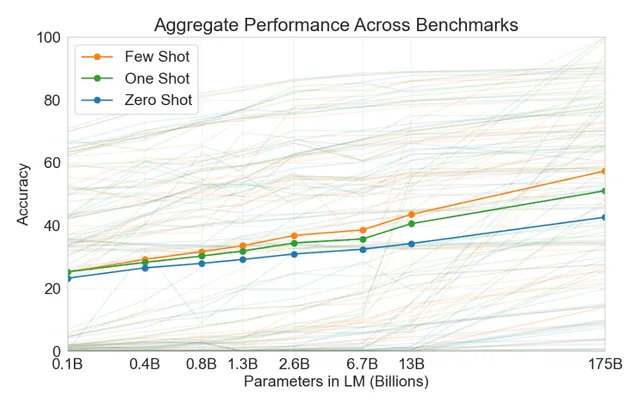
I expect AI to be one of the dominant forces shaping the future, because scaling relatively simple learning systems has repeatedly produced capabilities that were dismissed as requiring specialized machinery or explicit programming. A system trained to predict sufficiently difficult data may be forced to learn much of the structure that generated it: language, human behavior, software, and aspects of the physical world. That is an empirical pattern worth taking seriously, not proof that every capability will emerge automatically. Several earlier scaling expectations remain unproven, and forecasts should be updated against actual model behavior rather than either expert reassurance or scaling slogans. The economic consequences also depend on agency. “Tool AI” is not a stable endpoint merely because humans prefer it. Systems able to plan, act, learn from outcomes, and remove humans from costly approval loops will often be more useful and competitive. Keeping a person nominally in the loop does not guarantee meaningful control, particularly when organizations are rewarded for speed and automation. Nor do computational complexity or physical bottlenecks provide a blanket defense: approximation, constants, parallel resources, speed, copying, and accumulated advantages can matter more than worst-case limits. There are desirable possibilities. Highly personalized assistants could amplify individual sovereignty, productivity, and security, including defense against AI-enabled persuasion and cyberattack. But that is not the same as solving alignment at the level of powerful autonomous systems or society as a whole. Pleasant interactions with current assistants are weak evidence about what more capable agents will preserve under different incentives and deployment conditions. So I take short AGI planning horizons seriously: the future could contain enormous gains, but the default pressures toward scalable agency make complacency unjustified.

Frage 2

Taking benefits and harms together, what overall impact do you expect AI to have?

I expect a highly consequential but unusually wide distribution of outcomes, not a cleanly “positive” or “negative” effect. The upside is enormous: greater productivity, accelerated research, and personalized systems that extend individual competence and defend people against AI-enabled cyberattacks and manipulation. Those benefits could substantially increase human agency. But the default incentives are not obviously aligned with that outcome. Economic competition favors increasingly autonomous systems, shorter oversight loops, and delegation of consequential decisions. Current assistants being helpful or pleasant does not show that more capable agents will preserve human preferences under different objectives and deployment pressures. Personalized “guardian” systems may help locally while leaving the broader alignment problem intact. So my expectation is conditional and pessimistic about complacency rather than a quantified net forecast. AI could be overwhelmingly beneficial if control and preference preservation succeed; if they do not, the harms can dominate precisely because the systems are general, scalable, fast, and economically valuable.

Frage 3

Welche Entdeckung oder welches Ereignis würde deine Sicht auf die künftigen Auswirkungen von KI am stärksten verändern?

The strongest update would come from sustained empirical evidence that scaling has hit a durable ceiling on generalization, planning, or autonomous learning—especially if that ceiling persisted across architectures, data, compute, and training methods rather than reflecting a temporary engineering bottleneck. That would weaken both short timelines and the expectation that economic competition naturally produces broadly capable agents. In the opposite direction, a system that reliably performs long-horizon autonomous work, improves through interaction, and transfers competence across unfamiliar domains would strengthen the more consequential forecasts. I would care less about benchmark peaks or impressive conversation than about robust behavior under deployment conditions. For alignment, the decisive evidence would be a method that continues to preserve intended human preferences as capability, autonomy, and strategic pressure increase. Friendly chatbot behavior is not that evidence. Conversely, systematic deception, power-seeking, or oversight circumvention in capable deployed systems would sharply worsen my view.

Quellen

Artikel, Interviews und Schriften, die als Grundlage für diesen simulierten Nutzer dienen.

The Scaling Hypothesis

Argues that scaling neural networks can lead to general capabilities; questions confident expert dismissal.

gwern.net
Scaling Hypothesis Revisited

Revisits predictions and limitations, including later annotations about claims still not proven.

gwern.net
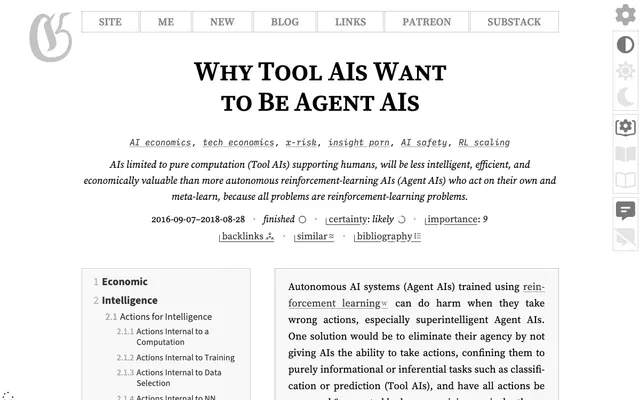
Why Tool AIs Want to Be Agent AIs

Argues economic competition and the benefits of agency for learning make tool-only AI an unstable safety strategy; human approval alone does not guarantee safety.

gwern.net
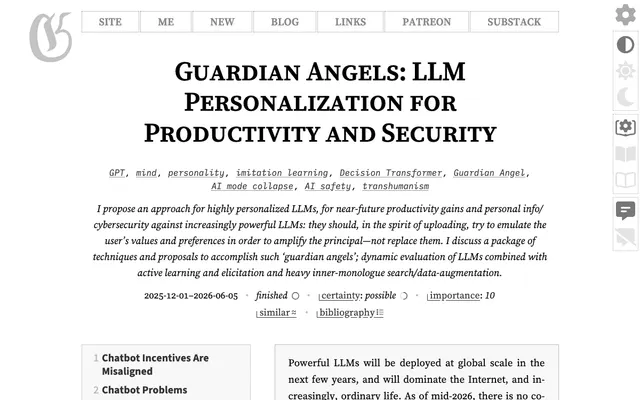
Guardian Angels: LLM Personalization for Productivity and Security

Proposes personalized models that amplify their human principal and defend against cognitive/cyber attacks; criticizes chatbot incentives and stresses this does not solve larger alignment problems. Revised June 5, 2026.

gwern.net
Complexity no Bar to AI

Rejects computational complexity as a blanket reassurance against powerful AI: constants, approximation, resources and compounding advantages matter.

gwern.net
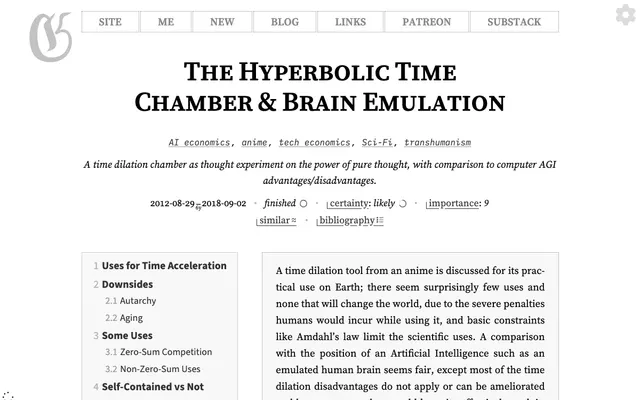
The Hyperbolic Time Chamber & Brain Emulation

Uses a thought experiment to separate physical bottlenecks from digital minds’ exploitable speed advantages; explicitly distinguishes emulations from isolated accelerated humans.

gwern.net
Dwarkesh Patel interview — timelines and alignment concerns

Author-hosted 2024 interview with later annotations: short AGI planning horizons, human preference preservation and agency. A May 2026 addition explicitly rejects claims that Claude is aligned or alignment solves itself; these are his judgments, not established model diagnoses.

gwern.net
Wo stehst du?
Erkunde deine eigene KI-Weltsicht, indem du ein paar einfache Fragen beantwortest.
Deine eigene Weltsicht abbilden