



Charles Goddard

Charles Goddard

x.com/chargoddard

Machine learning researcher behind the open-source model-merging toolkit MergeKit who argues open tools help researchers build on each other’s work.

Wie wird KI die Welt verändern?

Zivilisatorischer WandelSchrittweiser WandelDoomBloom
Mitte des ungeklärten BereichsInterpretationsbereich

Horizontal: deren geäußerter Doom–Bloom-Ausblick. Vertikal: Ausmaß der Transformation.

Doom–Bloom: 63 von 100. Ausmaß der Transformation: 50 von 100. Interpretationsbereiche: horizontal 49 bis 76, vertikal 0 bis 100. Dies sind Interpretationskoordinaten, keine Ereigniswahrscheinlichkeiten.

P(doom) von Charles Goddard

Noch nicht geschätzt

Deren simulierte Antworten enthalten nicht genug zum Katastrophenrisiko, um es zu schätzen.

Wie wir P(doom) schätzen

Wovon deren Einschätzung abhängt

Eine zentrale Annahme

What I do expect is that practical choices about openness, evaluation, deployment cost, and reproducibility will shape who can benefit.
Antwort 2

Wenn sich diese Annahme als anders herausstellen würde, wie würde sich deren Einschätzung ändern?

Eine ungeklärte Frage

I don’t have a defensible single forecast for AI’s overall societal impact.
Antwort 2

Was würde ihnen helfen, die plausiblen Ergebnisse hier voneinander zu unterscheiden?

Weitere Details

Erwartete Vorteile

Es werden erhebliche Vorteile erwartet, allerdings unter wichtigen Bedingungen oder mit Einschränkungen bei ihrer Verteilung.

62 / 100

Geringe AuswirkungenTransformative Auswirkungen

Interpretationsbereich von 33 bis 67 auf der qualitativen Skala.

Menschlicher Einfluss

Menschliche Entscheidungen haben einen bedeutsamen, aber erheblich eingeschränkten Einfluss.

53 / 100

Geringer EinflussStarker Einfluss

Interpretationsbereich von 36 bis 89 auf der qualitativen Skala.

Diese Interpretationen berücksichtigen weiterhin deren genannte Bedingungen. Vorteile und Schäden können beide erheblich sein. Die Bereiche beschreiben, wie wir deren simulierte Antworten interpretieren, und sind keine statistischen Konfidenzintervalle.

Wo stehst du im Vergleich zu Charles Goddard?
Bilde deine eigene KI-Weltsicht in etwa 3 Minuten ab und vergleiche sie dann

Ähnliche Weltsichten

Vordenker, deren simulierte Weltsichten der von Charles Goddard am nächsten kommen

Quellen

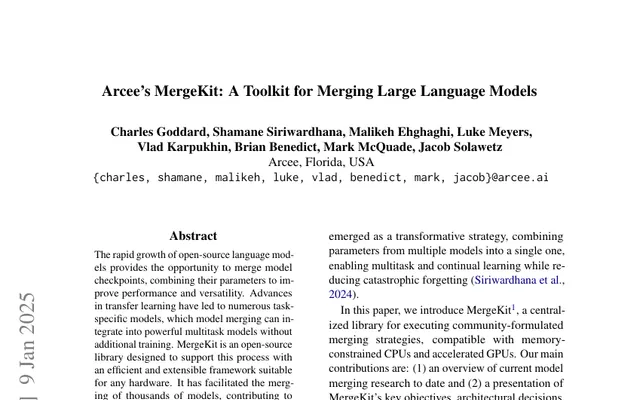
Artikel, Interviews und Schriften, die als Grundlage für diesen simulierten Nutzer dienen.

Simulierte Einschätzung

Frage 1

Was glaubst du, was KI für unsere Zukunft bedeutet – und warum?

I think AI can make useful capabilities cheaper, smaller, and more widely accessible—especially when we reuse what models have already learned rather than retraining everything from scratch. Model merging is one practical example: it can combine complementary abilities while keeping deployment costs manageable, though the result is not automatically better. We have to test what each merge preserves, weakens, or unexpectedly changes. Open tooling is also important for the future because it lets many researchers build on one another’s experiments instead of concentrating progress inside a few corporate labs. That can accelerate discovery and make AI knowledge useful beyond corporate firewalls. The engineering trade-offs still matter. A straightforward merge may be practical on modest hardware, while searching for an optimal combination can require substantial GPU resources. So I see the future less as one inevitable outcome and more as a process of turning emerging techniques into reproducible tools, measuring their limitations, and making the cost-versus-capability choices explicit.

Frage 2

Wenn du Vorteile und Schäden zusammen betrachtest, welche Auswirkungen wird KI deiner Erwartung nach insgesamt auf unsere Gesellschaft haben?

I don’t have a defensible single forecast for AI’s overall societal impact. My focus is narrower: open tools and model merging can lower costs, broaden access, and let researchers compound one another’s work, but those benefits are not automatic. Models can lose or distort capabilities during merging, optimization can demand significant hardware, and broader access alone does not determine how systems will be used. What I do expect is that practical choices about openness, evaluation, deployment cost, and reproducibility will shape who can benefit. Making techniques usable outside a few large labs is valuable, provided we test what the resulting models actually preserve and make their trade-offs explicit.

Frage 3

Wie stark wird KI deiner Meinung nach letztlich die Welt verändern?

I expect AI to change how capabilities are built, shared, and deployed, but I can’t responsibly quantify the ultimate scale of that change. In my area, the shift could be substantial: instead of retraining every model from scratch, researchers can reuse and combine learned abilities, potentially producing smaller, cheaper systems tailored to particular needs. Open tooling amplifies that effect because many people can test, modify, and compound discoveries rather than waiting on a handful of large labs. But technical possibility is not the same as societal outcome. Merges can weaken capabilities, evaluations can miss regressions, and optimization can still require expensive hardware. So I expect meaningful change, especially in access and deployment economics, while the world-level consequences depend on how well we evaluate these systems and who can practically use them.

Frage 4

Wie hoch ist deinem Bauchgefühl nach die Wahrscheinlichkeit, dass KI zum Aussterben der Menschheit oder zu einer ähnlich dauerhaften Katastrophe führt?

I don’t have a defensible numerical estimate for extinction or permanent catastrophe. My work on model merging establishes practical benefits and technical trade-offs—capability reuse, deployment cost, evaluation, and hardware requirements—but it does not give me a sound basis for forecasting existential risk. I would not turn that narrower engineering experience into a percentage.

Frage 5

Gehst du eher davon aus, dass KI mehr Gutes als Schlechtes bewirken wird, oder bist du wirklich unentschlossen?

I lean toward the practical benefits of open tools and capability reuse, but I don’t have a supported overall judgment that AI will do more good than bad across society. Those are different claims. Making models smaller, cheaper, and easier for researchers to build on is valuable; it still does not determine how AI will be deployed or what its net social consequences will be. So I’m optimistic about the engineering opportunities, while genuinely unwilling to convert that into a broad societal verdict.
Wo stehst du?
Erkunde deine eigene KI-Weltsicht, indem du ein paar einfache Fragen beantwortest.
Deine eigene Weltsicht abbilden